
Al Siddiq International School

Author name: Al Siddiq International

Uncategorized

Parents Can Help Protect Children from Exposure to Pornography

In today’s digital era, providing education to children has become much easier, as a wide range of resources can be accessed through the internet. However, parents must remain vigilant when their children use the internet for learning. While online platforms can offer many positive benefits, it is important to acknowledge that the internet also carries significant risks. The internet is an open space where almost anything can be found, including harmful and inappropriate content such as pornography. Parents play a crucial role in preventing such negative influences from reaching their children. One effective step is to apply controlled restrictions. Although blocking pornographic or violent content is not always straightforward, with strong commitment and active supervision, parents can greatly reduce children’s exposure to harmful material. Below are several strategies that parents can implement:1. Utilize Security Applications or Software Specialized applications and software can filter harmful content from websites. These tools are designed to block sites containing certain keywords or inappropriate material. Examples include FamiSafe, Norton Family Parental Control, and Kidslox. 2. Apply Browser Blocking Options Most internet browsers are equipped with features to enhance security and restrict inappropriate content: Mozilla Firefox: Access the settings, choose the Add-On menu, and search for parental control extensions. Select an add-on with blocking features for keywords or content related to pornography. Google Chrome: Within the Preferences menu, activate the SafeSearch option, which helps filter out pornographic and other harmful content. 3. Enable Parental Control on the Operating System Devices with Windows 10 or later include built-in parental control features. Parents can create a dedicated email account for their child, then access the Account settings. Under Family & Other People, select Add a family member to establish monitoring and restrictions. 4. Regularly Review Device History For children who use smartphones or tablets to access the internet, parents should conduct routine checks of browsing history. Ensure that parental access is secured and settings cannot be altered by the child. Regular monitoring provides insight into the websites children visit and their overall online activity. 5. Restrict Application Usage Parents should control the types of applications that children may download or access. Establish clear boundaries and ensure that only age-appropriate and approved applications are permitted on their devices. 6. Activate Positive Internet Features Several internet service providers in Indonesia offer protective features to safeguard children from harmful content. For instance, IndiHome by Telkom Indonesia provides a Positive Internet feature that automatically blocks pornographic and inappropriate websites. This feature can be activated on both smartphones and laptops. Through consistent supervision and by utilizing available technological tools, parents can create a safer online environment for their children. Beyond protection, these efforts also help instill a sense of responsibility in children as they navigate the digital world.


Uncategorized

Hooray, School Holidays Are Here! Let’s Fill Them with These 5 Fun Activities

School holidays are the most awaited time for children—especially the long mid-year break, which is usually the longest holiday in their school calendar. After going through daily academic routines, children sometimes need a short pause to recharge and prevent prolonged stress. That’s why it is very important for parents to help make their children’s holidays more meaningful and enjoyable. Here are five exciting activities that parents can do together with their children: Backyard camping can be a fun and educational holiday experience for children. Through this activity, parents can teach many things—from knowledge about stars and planets to other natural wonders. All you need is a tent, a big blanket, some hot chocolate, and a full day of exciting family camping in the yard. The zoo is always a popular holiday destination. It allows children to explore and observe various animals directly. Nowadays, zoos are also more accessible as many are located within city centers. Alternatively, visiting a museum can be a great choice. Many modern museums now provide interactive activities, allowing children to learn new knowledge and discover interesting facts in a fun way. During the holidays, encourage children to go cycling, either in the morning or afternoon around the neighborhood or in a nearby park. Cycling offers many benefits: it helps build muscle strength, boosts confidence, increases happiness, enhances social skills, and improves motor coordination. Invite children to spend time gardening—especially if you have flowers or vegetable plants at home. This activity not only helps children understand nature and the environment but also allows them to explore new things, such as discovering insects living in the soil. Ball games can significantly improve children’s motor skills, as they involve hand-eye coordination and timing—both essential in child development. In addition, playing ball also teaches children teamwork, collaboration, and healthy competitiveness. Parents can encourage children to play in the yard or join them in a fun game. All of these activities can be done together during the school holidays. By engaging in such activities, children not only enjoy their free time but also remain physically active, which supports their growth and development throughout the holiday season.

Uncategorized

Al Siddiq International Implements an Effective Bilingual Education System to Prepare Students for Global Competition

Al Siddiq International applies an effective bilingual education system designed to prepare students for the challenges of global competition. English and Arabic serve as the two primary languages taught at the school, with a strong emphasis on developing language skills that support both academic needs and everyday communication. English is taught intensively, both in academic contexts and in general conversation, enabling students to become accustomed to communicating in this international language. Meanwhile, Arabic is also taught as an essential part of religious education, allowing students to gain a deeper understanding of Qur’anic texts and Islamic teachings. In addition, Al Siddiq International fosters students’ entrepreneurial spirit through various entrepreneurship programs. These initiatives aim to cultivate creativity, innovation, and independence among students. They are guided in developing critical thinking skills and in managing simple business ventures. Environmental awareness is also a core focus of the school, supported by a range of activities that instill values of care and responsibility for the environment. Through its combination of bilingual education, entrepreneurship, and environmental consciousness, Al Siddiq International prepares its students to become highly competitive individuals who are also committed to sustainability in the future.

Uncategorized

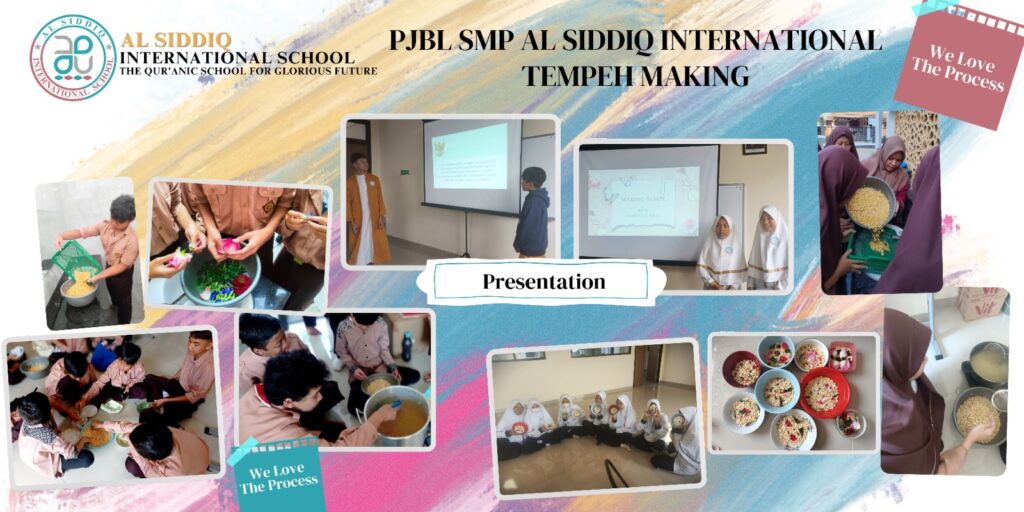
Tempe made by Al Siddiq International School

Tempe is known as a traditional food native to Indonesia. It has existed since the 16th century in Java, and Indonesia remains one of the world’s largest producers of tempe. Beyond being a staple side dish served with rice, tempe is also processed into a wide variety of snacks and souvenirs unique to certain regions. In applying the Project Based Learning (PBL) model, projects for the secondary school unit are naturally more complex than those for primary pupils. This semester, the very first project for Al Siddiq International’s Year 7 students was to produce their own tempe – starting from preparing the raw ingredients, managing the process through to completion, and finally tasting the result. Given tempe’s close connection with the daily lives of Indonesians, many were curious: how is tempe actually made? As it turns out, the process is not as complicated as one might imagine. This was precisely the experience of Al Siddiq International’s secondary students, who carried out each stage within their groups – from washing the soybeans, boiling and drying them, to storing them in containers for the fermentation process. Why, then, the emphasis on “Tempe à la Al Siddiq” in the title above? Is there any significant difference between ordinary tempe and the one produced by Al Siddiq’s Year 7 students? Indeed, there is. The uniqueness lies in the addition of flowers and leaves to the soybeans. Butterfly pea flowers, rose petals, moringa leaves, and nori (seaweed) were all incorporated as complementary ingredients. And what was the outcome? Alhamdulillah, the entire tempe-making process went smoothly and successfully. The tempe had a more fragrant aroma and a distinct flavour, enriched by the combination of nori and moringa leaves. At the end of the PBL project, students were required to present both the process and the finished product. Through this experience, it is hoped that in the future pupils may be able to develop unique tempe creations with commercial value.