

Al Siddiq International School

Edukasi

Aktivitas, Edukasi, Sekolah

Strengthening the Spiritual Foundation of Educators: The Teachers’ Ramadan Programme at Al Siddiq

In welcoming and filling the blessed month of Ramadan 1447H with meaningful activities, Al Siddiq International School has organised a special programme for teachers entitled the Al Siddiq Teachers’ Ramadan Programme. The activities are held daily from 23 February to 11 March 2026, from 1.00 p.m. to 2.00 p.m. (WIB), at Masjid Al Siddiq. This programme is designed as a platform for strengthening the spiritual well-being (ruhiyah) of educators, ensuring that Ramadan becomes not only a time for personal worship, but also an opportunity to enhance their character and commitment as teachers and role models for students. Ramadan Tausiyah: Refreshing the Heart and Mind One of the main highlights of the programme is the Ramadan Tausiyah delivered by Ustadz Abdullah Haris, Lc., M.Pd. In his reflections, he addresses themes such as the virtues of Ramadan, sincerity in good deeds, and the role of teachers as educators who not only impart knowledge but also instil values and noble character. Through these sessions, teachers are encouraged to view Ramadan as a school of self-improvement and a means of strengthening their dedication to nurturing a Qur’anic generation. Congregational Qur’an Recitation (Tadarus) In addition to the tausiyah sessions, the programme includes congregational Qur’an recitation. The serene atmosphere of Masjid Al Siddiq resonates with the collective recitation of the holy verses by the teachers. This activity aims not only to increase the quantity of recitation, but also to cultivate unity and togetherness in righteousness. The congregational tadarus becomes a moment of reflection and contemplation, reminding educators that the Qur’an is the primary source of inspiration in fulfilling their responsibility as teachers. Tahsin Learning in Halaqah Groups To enhance the quality of Qur’anic recitation, the programme also features tahsin (recitation improvement) sessions conducted in small halaqah groups. Each group is guided by a musyrif from among the asatidz (male and female teachers) of Al Siddiq. Within this more focused and structured setting, teachers work on improving pronunciation (makharijul huruf), rules of tajwid, and fluency. The halaqah system enables more personalised and effective guidance, ensuring that each participant receives support according to their individual needs. Rotational Activities, Consistent Commitment The activities rotate daily between tausiyah sessions, congregational tadarus, and tahsin learning. This format ensures that the programme remains dynamic and engaging, sustaining participants’ enthusiasm throughout Ramadan. With a duration of one hour each day following teaching activities, the programme serves as a spiritual oasis amidst the teachers’ busy schedules. Ramadan as a School for Educators The Al Siddiq Teachers’ Ramadan Programme demonstrates that the enhancement of educational quality begins with the development of its educators. Teachers who are spiritually grounded are better prepared to guide, inspire, and instil noble values in their students. May this programme draw teachers closer to the Qur’an, strengthen their character, and deepen their sincerity in carrying out their noble trust as educators. Ramadan is not only a month of worship, but also a month of growth and refinement—for both students and the teachers who lead by example.By Arief Firmansyah, S.Kom
Edukasi

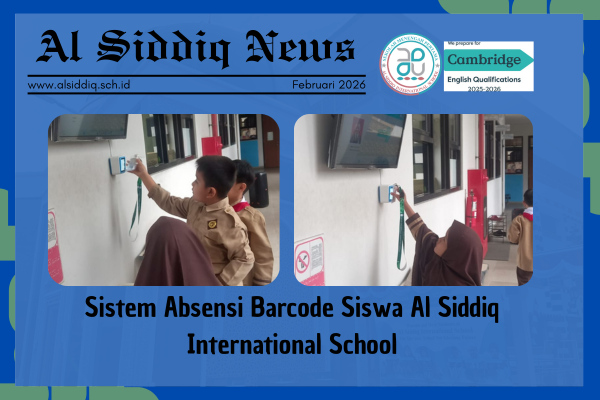
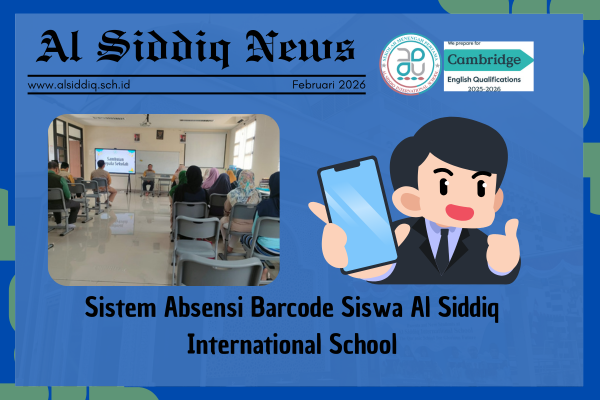
Digital Transformation in Schools: Student Barcode Attendance System at Al Siddiq International School

In today’s rapidly advancing digital era, Al Siddiq International School has introduced an innovative approach to school administration through a barcode-based digital attendance system. This programme utilises the Madani School System as its main platform, integrating student attendance data in real time in a transparent and efficient manner. Practical, Fast, and Accurate Each student is provided with an identification card equipped with a unique barcode. Upon arrival at school, students simply scan their barcode using the designated device. Within seconds, their attendance is automatically recorded in the system without the need for manual entry. This method not only accelerates the attendance process but also minimises recording errors and enhances data accuracy. The automated system enables the school to monitor student punctuality and attendance more effectively. Instant Reports for Parents One of the key advantages of this system is the automatic notification feature for parents. Whenever a student scans in upon arrival or departure, an attendance report is immediately sent to parents via the Madani School System application. This allows parents to be promptly informed of their child’s arrival and departure times. This feature provides reassurance and peace of mind for parents, while also strengthening communication between the school and families. The transparency of attendance data reflects the school’s accountability in ensuring students’ safety and discipline within the educational environment. Encouraging Discipline and Digital Literacy The implementation of digital attendance serves not only as an administrative tool but also as an educational medium. Students learn to be more disciplined in managing their time and to take responsibility for their attendance. At the same time, the structured use of technology fosters positive digital literacy from an early age. For the school administration, the system simplifies the compilation of daily, weekly, and termly attendance reports. The systematically stored data also supports more informed decision-making in student development and guidance. A Commitment to a Modern and Transparent School Environment The implementation of the barcode-based digital attendance system through the Madani School System demonstrates Al Siddiq International School’s commitment to delivering modern, efficient, and transparent educational services. This innovation aligns with the school’s vision of integrating Islamic values with technological advancement. With an integrated and responsive system in place, the school and parents can now collaborate more effectively in monitoring students’ progress and discipline. Attendance is no longer merely a daily routine, but part of a broader digital transformation that supports a safe, orderly, and professional learning environment.By Arief Firmansyah, S. Kom

Edukasi, Sekolah

Launching the eTahfizh Al Siddiq Application: A Digital Innovation for Monitoring Students’ Qur’anic Memorisation

As part of strengthening collaboration between school and parents in guiding students’ Qur’anic memorisation, SMP Al Siddiq International held a socialisation session on the use of the web-based eTahfizh Al Siddiq application during the Parent–Teacher Conference on 24 January 2026. This session became one of the key highlights of the meeting, introducing a digital innovation specifically designed to monitor students’ memorisation submissions in a more structured, transparent, and real-time manner. Presented Directly by the Programme Developer The session was delivered by Mr Arief Firmansyah, S.Kom, the creator and developer of the eTahfizh Al Siddiq programme. In his presentation, he explained the background behind the development of the application as a solution to the need for a more effective and well-documented memorisation monitoring system. Through this web-based platform, parents are able to track their children’s memorisation progress, including the number of verses submitted, target achievements, and evaluation notes from the tahfizh teachers. The system ensures that data is neatly stored and accessible anytime and anywhere. Transparency and School–Parent Collaboration During the demonstration session, parents were guided through the login process, how to read progress reports, and how to understand the memorisation achievement indicators. The participants showed great enthusiasm, raising various questions regarding technical usage and additional supporting features. The eTahfizh application is expected to strengthen collaboration between teachers and parents in supporting students’ memorisation journey. With open and accurate access to information, parents can provide more effective encouragement and assistance at home. Implementation Across All Levels As part of the school’s commitment to developing a technology-based tahfizh programme, starting from early February 2026, the eTahfizh Al Siddiq application will be officially implemented not only at the junior high level but also at the kindergarten and primary levels within Al Siddiq International School. This step marks a significant digital transformation in the school’s Qur’anic memorisation system and reflects its vision of integrating Islamic values with technological advancement. Towards a More Modern and Measurable Tahfizh System With the introduction of eTahfizh Al Siddiq, the process of monitoring memorisation is no longer solely manual, but supported by accurate and measurable data. The programme is expected to enhance the quality of tahfizh guidance, strengthen communication between school and parents, and foster greater motivation among students to achieve their memorisation targets. Through this innovation, Al Siddiq International School once again demonstrates its commitment to delivering high-quality education that is adaptive to modern developments while remaining firmly grounded in the values of the Qur’an.By Arief Firmansyah, S.Kom

Edukasi

Choosing the Right School for Your Child: Seven Key Factors Parents Should Consider

Most answers to the question of “How to choose the right school?” tend to be normative, such as: check whether the school has a good reputation or whether its students achieve high exam scores. While both are important considerations, they are not the only factors parents should focus on. Parents need to spend time understanding what kind of school will truly meet the needs of their children. Investing in education requires significant financial commitment, often incomparable even to purchasing a new house or car. That is why choosing the best school for our children can feel somewhat daunting—especially with the wide variety of schools available today. As parents, it is crucial to carefully evaluate a school before enrolling your child, since it is the child who will ultimately experience the education process. So, what essential aspects should you consider in selecting the right school for your children? The following points will help guide you: The primary factor that differentiates one school from another lies in the quality of its teaching staff and management. Schools with highly qualified, experienced teachers, supported by a competent management team, should be a top priority. First and foremost, parents need assurance that the teaching staff can provide a high-quality learning environment for their children. Beyond this, the competence of the school’s management ensures that all aspects of school operations are well-organized and effective. It is also important that the management is open to collaboration with parents in supporting their child’s educational journey. Another crucial factor is the curriculum. A strong curriculum not only emphasizes academic foundations but also places the child’s holistic development at its center. Check whether classroom activities are designed to help students develop essential life skills alongside academic knowledge. Parents should also evaluate the breadth of learning experiences offered within the school’s curriculum, ensuring their child benefits from both intellectual and personal growth. Once you are confident in the teaching staff and curriculum, the next priority is safety. After all, your child’s well-being must be the highest concern when entrusting them to a school. Parents should ask detailed questions when reviewing a school’s safety standards. For example: Does the school have designated evacuation areas? Are safety facilities in place? How do staff members handle emergency procedures? Why should parents review a school’s teaching methodology, even when teachers are well-qualified? Because methodology reflects how effectively teachers deliver lessons and engage students in their learning experience. Parents should check whether teachers employ innovative methods that make learning engaging and interactive. Does the school allow students to express their ideas in class? Are discussions and project-based learning encouraged? These approaches greatly enrich the educational process. Parents certainly do not want their children confined solely to a rigid academic schedule. Extracurricular activities are essential to provide balance, enjoyment, and opportunities for talent development. Activities such as sports, arts, scouting, or life skills programs not only serve as recreation but also play a significant role in developing children’s social abilities, teamwork, and creativity. Well-designed extracurricular programs complement the quality of the academic experience. Location is another key factor when choosing a school. Proximity matters not only for reducing transportation costs but also for supporting a child’s daily learning process. Parents should evaluate the distance between home and school, as well as available access or school-provided transportation services. A closer location helps children arrive on time, reduces fatigue, and enables them to better engage in their studies. Above all, parents should consider the school’s culture and values. What principles does the school uphold? Does it have a clear code of ethics? A healthy school culture promotes teacher professionalism, continuous learning, innovative environments, and a sense of responsibility. The values instilled in a school significantly influence students’ mindsets and character. Parents should also evaluate whether the school’s values align with those practiced at home. Conclusion These seven key factors serve as a comprehensive guide for parents seeking the right school for their children. There is no need for confusion or hesitation—especially in areas such as Jatimakmur, Pondok Gede—when clear indicators such as teaching quality, management, curriculum, methodology, and safety standards are available for verification. While methodology and safety require close evaluation, it is equally important to understand the culture and values promoted by the school. The best next step is to visit the school directly—so that parents can make an informed choice with confidence and register their children without hesitation. Adapted by Yusuf Yudhana