Numbers, Puzzles, and Circles: A Fun Assessment Day in TK B Al Siddiq
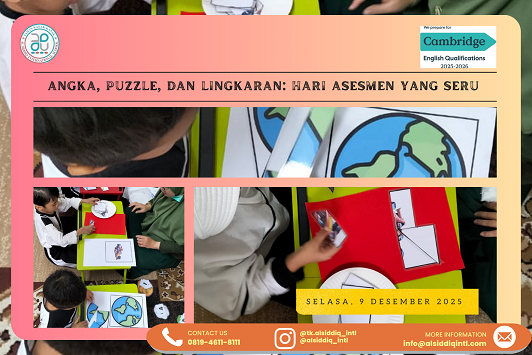
This mathematics assessment was designed to observe children’s basic understanding of numbers, patterns, sizes, and relationships between objects. The activities focused on abilities appropriate to the developmental stage of kindergarten children, particularly early numeracy skills and shape observation. The assessment was conducted in a simple manner so that the children felt comfortable and were able to demonstrate their abilities naturally. The participants in this activity were the students of TK B Al Siddiq. At this age, children are actively exploring their surroundings, so the assessment was made engaging and easy to follow. Each task was adjusted to suit their individual abilities, both for those who were already confident in counting and for those who still required visual support. The activity took place in the classroom, an environment that was already familiar to the children. This familiar setting helped them remain calm and focused. The classroom also allowed teachers to monitor each child closely and provide support whenever needed. The assessment was conducted on 9 December 2025. The choice of this date was aligned with the learning schedule so as not to disrupt other routines. With a clear timetable, teachers were able to prepare the materials, worksheets, and small-group arrangements to ensure the activity ran smoothly. The objectives of this assessment were linked to six areas of child development. First, cognitive development, including the ability to recognise numbers, distinguish sizes, and understand sequences. Second, fine motor development through activities such as writing numbers, drawing circles, and assembling puzzles. Third, language development, as children needed to understand instructions and, in some cases, explain their answers. Fourth, social development, shown when children waited for their turn and worked in small groups. Fifth, emotional development, which emerged as children learned to manage their confidence and patience. Sixth, moral development, reflected in orderly behaviour, taking turns, and completing tasks honestly. The assessment was carried out in stages. Teachers began by demonstrating how to complete the worksheets so that the children had a clear understanding of the tasks. While waiting to be called, the children worked on worksheets that included practising writing numbers from 1 to 20 and drawing circles according to the specified quantities. Every three children were then called to take part in the core assessment, which involved assembling puzzles and arranging objects from the smallest to the largest. This approach enabled teachers to observe each child’s abilities more closely without making them feel rushed. With this approach, the assessment was not merely an evaluation, but also an opportunity for children to learn and demonstrate their abilities in a positive and well-structured environment.By Inka Amalia, S.Pd