Al Siddiq International School

Kegiatan

Kegiatan, TK

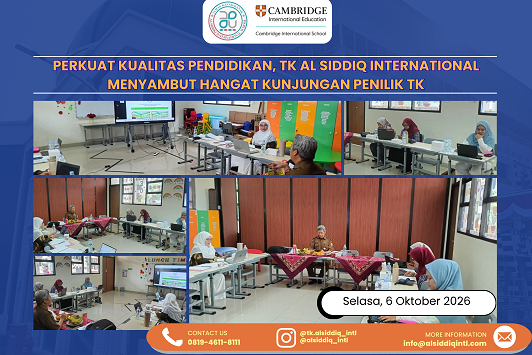
Strengthening Education Quality: TK Al Siddiq International Warmly Welcomes a Kindergarten Supervisor’s Visit

On Tuesday, 6 October 2026, TK Al Siddiq International welcomed a visit from a kindergarten supervisor as part of the coordination and monitoring of educational programmes implemented at the school. The meeting took place in the school’s meeting room and was attended by the kindergarten supervisor, Mr Riyadi and his colleagues, the Head of Kindergarten, and the administrative staff of TK Al Siddiq International.The visit served as an opportunity for coordination between the school and the kindergarten supervisor to support the implementation of educational programmes and administrative procedures. During the meeting, both parties discussed various matters related to Jabar Beraksi, including preparations and the implementation of tasks that needed to be completed by the educational institution. The meeting also provided an opportunity for the school to receive guidance and ensure that its documents and activities complied with the applicable regulations.In addition to coordinating with the school, the kindergarten supervisor conducted direct observations of the school’s facilities and educational activities. These observations aimed to provide an overview of how education is delivered at TK Al Siddiq International, including the learning environment and the implementation of activities that support the teaching and learning process. By observing the school directly, the supervisor could provide feedback tailored to the needs and circumstances of the institution.The visit focused not only on administrative completeness, but also on how the school implements its educational programmes and activities in practice. This was important to ensure that the documents and tasks prepared by the school were aligned with the activities taking place within the TK Al Siddiq International learning environment.For TK Al Siddiq International, the kindergarten supervisor’s visit provided a valuable opportunity for evaluation and continuous improvement. The guidance and outcomes of the discussions can serve as a reference for refining various aspects of educational management, including administration, school programmes, and readiness to carry out tasks related to Jabar Beraksi.Through this activity, TK Al Siddiq International continues to strive to maintain the quality of its educational services and comply with the relevant requirements. Collaboration between the school and the kindergarten supervisor is expected to support better, more organised educational management that meets the school’s developmental needs.The visit, conducted in a collaborative and constructive atmosphere, also reflected TK Al Siddiq International’s commitment to continuous improvement and the enhancement of educational services. Through monitoring, observation, and direct communication, the school gained valuable feedback and guidance to support its ongoing development and provide the best possible learning experiences for its children. By Inka Amalia, S.Pd

Kegiatan, SD

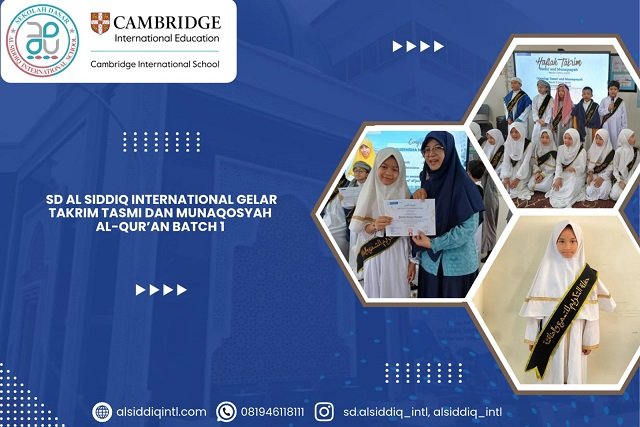
SD Al Siddiq International Holds Batch 1 Qur’an Memorisation Recitation and Assessment Ceremony

Bekasi, 9 October 2026 — SD Al Siddiq International held the Batch 1 Takrim Tasmi and Munaqosyah Al-Qur’an ceremony on Friday, 9 October 2026. The event served as a form of appreciation for students who had completed their Qur’an memorisation targets, while also providing an opportunity to assess the quality of their memorisation, build confidence, and nurture a love for the Qur’an from an early age.The event was attended by 14 students who had completed their memorisation at several levels: Juz 30; Juz 29 and 30; and Juz 28, 29, and 30. These achievements were the result of consistent learning, practice, and murajaah (regular revision of memorised verses).During the tasmi session, students recited the Qur’an aloud, demonstrating the verses they had memorised. Meanwhile, munaqosyah formed part of the assessment process, evaluating the accuracy of their memorisation, fluency of recitation, and ability to recite Qur’anic verses correctly. Both activities played an important role in maintaining the quality of memorisation while helping students develop greater self-confidence.The Batch 1 Takrim Tasmi and Munaqosyah ceremony focused not only on the number of juz memorised, but also on the development of Islamic character. Through this process, students were encouraged to cultivate discipline, dedication, patience, and responsibility in maintaining their Qur’an memorisation. The activity also aimed to instil an understanding that memorising the Qur’an is not simply about completing a certain number of juz, but rather the beginning of a lifelong journey of engaging with the Qur’an in everyday life.For SD Al Siddiq International, this event reflects the school’s commitment to Qur’anic education and nurturing a generation grounded in the Qur’an and noble character. The school strives to create a learning environment that encourages students to love the Qur’an, improve their recitation and memorisation, and put its teachings into practice.Appreciation was also extended to the parents who consistently accompanied and supported their children throughout their memorisation journey. Family involvement is an important factor in sustaining children’s motivation to learn, revise their memorisation, and strengthen their connection with the Qur’an. Through strong collaboration between the school and parents, the school hopes to ensure that Qur’anic education continues consistently both at school and at home.Through the organisation of the Batch 1 Takrim Tasmi and Munaqosyah ceremony, SD Al Siddiq International hopes to inspire more students to improve their memorisation and enhance the quality of their Qur’an recitation. The participants’ achievements are expected to serve as an inspiration for the entire student community to persevere, remain enthusiastic about memorisation, and make the Qur’an a guiding light in their lives.May every verse memorised become a light for the students, bring blessings to their families, and serve as a foundation for them to grow into a generation that is knowledgeable, faithful, and distinguished by noble character.SD Al Siddiq International — Nurturing a Qur’anic Generation of Excellence and Noble Character. By Muslihatul Maula, Lc

Kegiatan, SMP

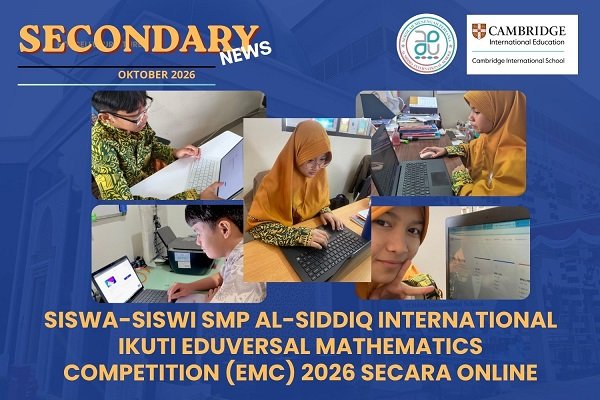
SMP Al-Siddiq International Students Take Part in the Eduversal Mathematics Competition (EMC) 2026 Online

Bekasi, 11 October 2026 — Students of SMP Al-Siddiq International took part in the Eduversal Mathematics Competition (EMC) 2026, a mathematics competition hosted on the Arena.competzy.net platform. The competition was held online, allowing participants to complete the questions from their respective homes.Participation in this competition was part of SMP Al-Siddiq International’s efforts to encourage the development of students’ academic potential, particularly in mathematics. Through this competition, students were expected to sharpen their logical, analytical, and critical thinking skills, while improving their accuracy and confidence in solving a variety of mathematical problems.The nine SMP Al-Siddiq International students who participated in the Eduversal Mathematics Competition (EMC) on 11 October 2026 were:

Kegiatan, TK

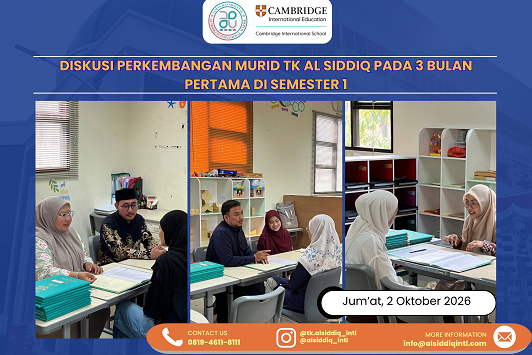
Discussing TK Al Siddiq Students’ Development During the First Three Months of Semester 1

On Friday, 2 October 2026, TK Al Siddiq International held its Mid-Semester 1 Report Card Distribution for all students. The activity took place in each classroom and involved teachers and parents or guardians. This report card distribution was an important opportunity for the school and families to reflect on and better understand the children’s development during their first three months of learning at school.The report card distribution was not merely an occasion to communicate learning outcomes, but also an opportunity for teachers and parents to discuss each child’s progress directly. Through these meetings, parents gained an overview of their children’s learning processes, abilities, and development throughout various school activities. Two-way communication between teachers and parents was expected to support more appropriate and continuous guidance for every child.To ensure that the activity ran smoothly and comfortably, parents arrived according to their previously agreed appointment times. Upon arrival, parents or guardians first met with their respective homeroom teachers. During this session, the homeroom teachers presented and discussed the children’s academic reports, including their progress throughout classroom learning activities.After meeting with the homeroom teachers, parents continued with a session alongside the Qur’an teachers. This session focused specifically on the children’s progress in Qur’an learning. The Qur’an report covered several aspects, including Tahfidz (Qur’an memorisation), Tahsin (improving Qur’an recitation), and the ability to recite various prayers that the children had learnt during their first three months at school.In the Tahfidz aspect, teachers shared updates on the children’s Qur’an memorisation progress in accordance with the lessons provided. Meanwhile, in Tahsin, parents received information about their children’s developing ability to recite the Qur’an correctly and properly, according to their individual learning stages. The discussion also covered the children’s progress in reciting prayers, including hadith and short supplications they had learnt.Through the Mid-Semester 1 report card distribution, the school hopes that parents will not only become aware of their children’s progress, but also gain a better understanding of the learning journey they have undertaken at school. Every child develops at their own pace and has unique characteristics. Therefore, report cards serve as a means of recognising achievements while identifying the next steps for appropriate guidance and support.This activity also demonstrated the importance of collaboration between the school and families in supporting children’s growth and development. Through open communication among homeroom teachers, Qur’an teachers, and parents, every child is expected to receive guidance suited to their individual needs, both in academic learning and in Qur’an education and Islamic values.The Mid-Semester 1 Report Card Distribution at TK Al Siddiq International provided a valuable opportunity for the school and parents to appreciate every stage of the children’s learning journey and achievements during their first three months. May this collaboration continue to grow stronger, enabling the children to develop into confident, well-rounded individuals who flourish in a supportive learning environment. By Inka Amalia, S.Pd

Kegiatan, SD, Uncategorized

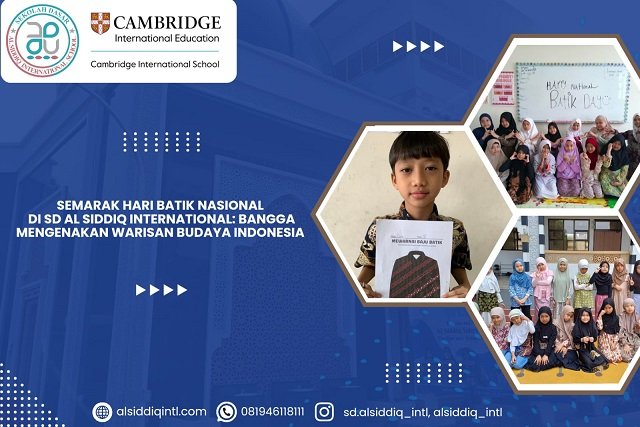
Celebrating National Batik Day at SD Al Siddiq International: Proud to Wear Indonesia’s Cultural Heritage

To commemorate National Batik Day, which fell on Friday, 2 October 2026, the SD Al Siddiq International community joined in the celebration by wearing batik clothing. This simple yet meaningful activity was an opportunity to nurture students’ love, pride, and appreciation for Indonesian culture from an early age.From the morning, the school was filled with a more vibrant atmosphere as students and teachers arrived wearing batik in a variety of patterns and colours. The beautiful designs created a cheerful setting while showcasing the richness and diversity of Indonesian culture. The students also appeared enthusiastic and confident as they wore batik during their learning activities at school.National Batik Day is not merely about wearing clothing with batik patterns; it is also an opportunity for students to become more familiar with one of Indonesia’s cultural treasures and a significant part of the nation’s identity. Batik has a long and rich history, reflecting artistic values, creativity, and philosophy. Different regions across Indonesia have their own distinctive batik patterns and characteristics, making batik a wonderful representation of the cultural diversity of the Indonesian archipelago.Through this activity, students were encouraged to understand that preserving culture can begin with simple actions in everyday life. Wearing batik is one way to show appreciation for the nation’s cultural heritage. Students can also learn to value the creative process, artistic expression, and craftsmanship of batik artisans, who produce these beautiful works with great care, precision, and patience.Wearing batik also formed part of character education at SD Al Siddiq International. The school strives not only to provide academic education, but also to develop students’ character so that they become confident individuals who appreciate diversity, love their culture, and take pride in being part of the Indonesian nation. These values are important to nurture from an early age, helping children grow into open-minded individuals who remain firmly connected to their cultural roots.The cheerful atmosphere grew even warmer as students and teachers wore batik together, creating a strong sense of togetherness throughout the school. The occasion provided an opportunity to strengthen the bonds among members of the school community. It also helped students realise that Indonesian culture is closely connected to their everyday lives and can be celebrated in enjoyable and meaningful ways.The National Batik Day celebration also taught students that preserving cultural heritage is not solely the responsibility of the government or artists, but a shared responsibility. Young people have an important role to play in ensuring that Indonesian culture continues to thrive. By learning about, wearing, appreciating, and introducing batik to others, children can contribute to preserving this cultural heritage so that it remains known, valued, and loved by future generations.For SD Al Siddiq International, this activity is expected to provide students with a simple yet memorable positive experience. The spirit of wearing batik should not end with a single commemorative day, but should inspire students to appreciate Indonesian culture as part of their everyday lives.Through the spirit of National Batik Day 2026, SD Al Siddiq International continues to encourage students to become knowledgeable, confident, well-rounded individuals who take pride in their national culture. May their love for batik and Indonesian cultural heritage continue to grow and become an important part of their journey towards discovering and preserving the richness of the Indonesian archipelago.Happy National Batik Day 2026!Proud to Wear Batik, Proud to Preserve Indonesian Culture. By Muslihatul Maula, Lc

Kegiatan, SMP

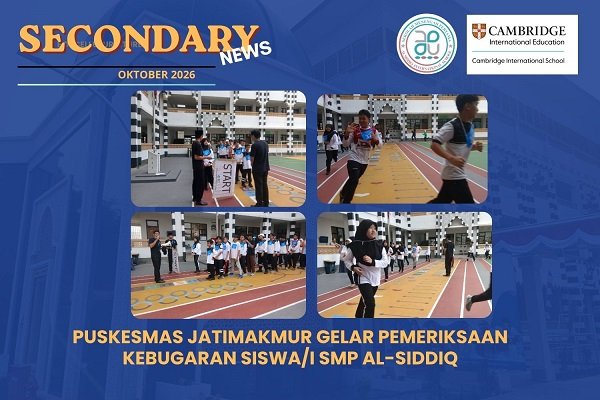
Jatimakmur Community Health Centre Conducts Student Fitness Assessments at SMP Al-Siddiq International

Bekasi, 30 September 2026 — SMP Al-Siddiq International once again organised an activity to support students’ health and physical fitness through a fitness assessment in collaboration with Jatimakmur Community Health Centre (Puskesmas Jatimakmur) on Wednesday, 30 September 2026. The activity took place on the school field and was attended by students as part of the school’s ongoing efforts to raise awareness of the importance of maintaining good health and fitness from an early age.The activity provided students with an opportunity to assess their physical fitness through structured physical exercises. In addition to supporting health education, it also gave students practical experience of the importance of physical activity and a healthy lifestyle.Assessing Physical Fitness and EnduranceOne of the main activities in the fitness assessment was a running test, during which students were asked to complete 11 laps, covering a total distance of approximately 1,000 metres on the school field.The test was designed to provide an indication of students’ physical capabilities, particularly their cardiorespiratory endurance—the body’s ability to use oxygen effectively during physical activity.Throughout the activity, students were also encouraged to pay attention to their bodies’ responses to exercise, including changes in heart rate, breathing, fatigue, and their ability to sustain physical activity.In this way, students were not simply exercising; they were also learning to recognise how their bodies function when engaged in physical activity.Objectives of the Fitness AssessmentThe fitness assessment had several important objectives:

Kegiatan, TK

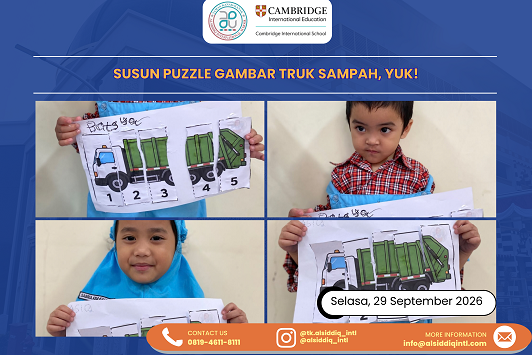
Let’s Put Together a Garbage Truck Puzzle!

On Tuesday, 29 September 2026, the children of TK A Al Siddiq International took part in an enjoyable learning activity in the Preparation Centre. This time, the children were invited to complete a puzzle featuring a garbage truck while also learning to recognise the numbers 1 to 5. Through learning while playing, the children were encouraged to develop a range of foundational skills in ways appropriate to their stage of development.The activity began with a warm welcome from the teacher as the children arrived in the classroom. They then took part in attendance and an ice-breaking activity to create a cheerful and enjoyable learning atmosphere. The teacher subsequently invited the children to discuss the types of rubbish they commonly encounter in everyday life. The children were introduced to four types of waste: organic waste, paper, plastic, and hazardous and toxic waste (B3). This introduction provided an opportunity for the children to begin understanding the importance of recognising and sorting waste according to its type.After the introduction, the children were presented with the garbage truck puzzle. They were encouraged to arrange the individual puzzle pieces until they formed a complete picture. The puzzle activity was designed to develop their thinking skills, concentration, hand-eye coordination, and problem-solving abilities. The children also learnt to be patient, try again when they encountered difficulties, and complete a task step by step.Interestingly, the puzzle activity focused not only on completing the picture. The children also learnt to recognise the numbers 1 to 5. Each puzzle piece was arranged according to the numerical sequence, allowing the children to connect number symbols with the process of putting the picture together. In this way, numbers were introduced through a concrete and enjoyable activity, allowing the children to learn naturally without feeling as though they were simply memorising.In addition to learning about numbers, the children were also introduced to the letters in their own names. The teacher gave them opportunities to observe and identify the letters found in their respective names. This activity helped develop their awareness of letter shapes and sounds while providing an early foundation for literacy development.Through this activity, the TK A Al Siddiq International children experienced an integrated learning experience. In a single activity, they were able to develop their cognitive abilities, fine motor skills, language skills, and concentration. The learning also became more meaningful because it was presented through play and connected to everyday life, particularly learning about waste and the importance of keeping the environment clean.The activity at the Preparation Centre demonstrates that early childhood learning can take place through simple, enjoyable, and meaningful experiences. With guidance from their teacher, the children were not only learning to complete a puzzle, but also learning about numbers, letters, different types of waste, and the importance of being careful, independent, and responsible.May this enjoyable learning experience become part of the children’s journey as they discover their environment and develop essential skills from an early age. By Inka Amalia, S.Pd

Kegiatan, SD

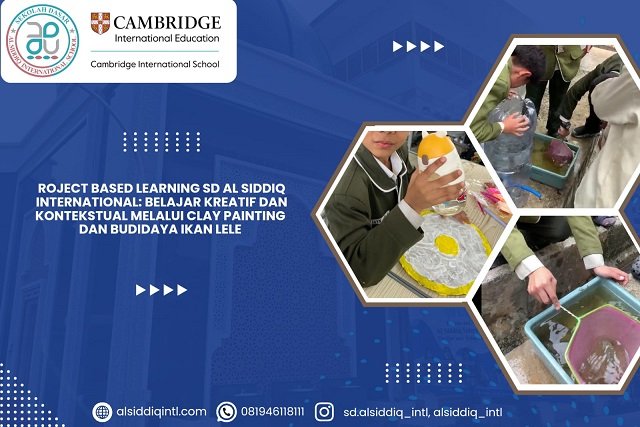
Project Based Learning at SD Al Siddiq International: Creative and Contextual Learning through Clay Painting and Catfish Farming

SD Al Siddiq International once again provided students with a creative and meaningful learning experience through its Project Based Learning (PjBL) programme on Thursday, 1 October 2026. Held from 10.00 to 11.00 a.m., the activity gave students the opportunity to learn through direct experience, creativity, teamwork, and simple practical activities connected to everyday life.Project Based Learning is a learning approach that encourages students to become actively involved in completing a project. Through this approach, students do not simply receive theoretical knowledge, but also gain first-hand experience by creating, observing, experimenting, and producing a work or project. As a result, learning becomes more enjoyable while helping students develop a wide range of skills.During this activity, Grades 1–3 took part in a project entitled “Creating a Painting from Clay”. The students were invited to explore their creativity by using clay and transforming it into an engaging work of art. By using clay in different shapes and colours, students were able to express their ideas and imagination through their creations.Creating paintings from clay was an enjoyable experience for the students. They learnt how to shape, arrange, and combine different colours to produce artwork according to their individual creativity. The activity also helped develop their fine motor skills, attention to detail, patience, and ability to follow the stages of a project.Beyond developing creativity, the activity provided students with an opportunity to express themselves. Each piece of artwork had its own unique form and character because it was created based on each student’s individual ideas and imagination. This taught the children that every individual has unique creativity that deserves to be appreciated.Meanwhile, Grades 4 and 6 took part in a “Catfish Farming” project. Through this activity, students were introduced to basic concepts of fish farming and care through practical experiences connected to everyday life. They were able to observe the materials and environment used for fish farming while learning that raising and caring for fish requires attention, careful observation, and responsibility.Through the catfish farming project, students also gained a more contextual learning experience. They were able to understand that the knowledge learnt at school can be applied to real-life situations. The activity also encouraged curiosity about the environment, living things, and the processes involved in caring for and raising animals.The implementation of these two projects demonstrates SD Al Siddiq International’s commitment to providing students with diverse learning experiences. Through Project Based Learning, students are encouraged to become active, creative, independent learners who are able to work collaboratively. They are not only learning to know, but also learning by doing and experiencing.The activities also provided an opportunity for students to develop essential 21st-century skills, including creativity, collaboration, critical thinking, communication, and problem-solving. Through a project-based learning approach, students are expected to build greater confidence while gaining memorable and meaningful learning experiences.With great enthusiasm, the students participated in every stage of the activities and enjoyed the process of learning together. Through experiences such as these, SD Al Siddiq International continues its commitment to providing learning that is active, creative, enjoyable, and relevant to students’ everyday lives.Learning through creating, learning through trying, and learning through real-life experiences. By Muslihatul Maula, Lc

Kegiatan, SMP

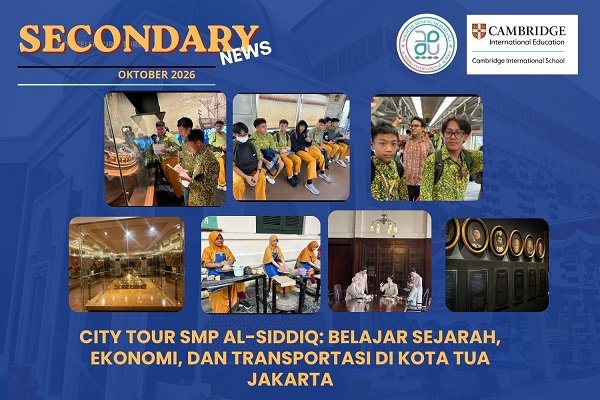
SMP Al-Siddiq City Tour: Exploring History, Economics, Art, and Transport in Jakarta’s Old Town

Jakarta, 29 September 2026 — Learning does not always have to take place inside the classroom. This was experienced first-hand by students of SMP Al-Siddiq during an educational City Tour to Jakarta’s historic Old Town (Kota Tua) on Tuesday, 29 September 2026.Beginning at 8.30 a.m. from Cikunir 1 LRT Station, the activity provided students with a valuable opportunity to learn through direct experience by visiting the Bank Indonesia Museum, Fatahillah Museum (Jakarta History Museum), and an Art Museum.The trip went beyond learning about history. Students were also introduced to the use of public transport, electronic payment systems, the development of Indonesia’s economy, art and culture, and various historical artefacts that form an important part of the nation’s journey.Learning About Public Transport from the Very BeginningThe learning experience began from the moment the journey started. The group travelled by LRT and KRL to reach the Kota Tua area.The use of public transport was deliberately incorporated into the activity so that students would not simply become passengers, but would also gain first-hand experience of how public transport systems operate in an urban environment.Students were also introduced to the use of e-money as a means of payment. This simple experience provided practical learning about the use of technology in everyday life while also developing independence, discipline, and awareness of proper conduct when using public facilities.To ensure that the journey remained safe and well organised, the students were divided into 11 groups, with each group accompanied by a homeroom teacher. This system enabled supervision, guidance, care, and communication with students to be carried out more effectively.Tracing Indonesia’s Economic History at the Bank Indonesia MuseumUpon arriving in Kota Tua, the group visited the Bank Indonesia Museum.At the museum, students had the opportunity to explore the history of Indonesian currency and the national economy throughout different periods. Various collections illustrated the development of means of payment from the arrival of the Portuguese, Spanish, and Dutch, through to the development of Indonesian currency in the modern era.Students observed different forms of currency, including banknotes and coins, as well as various objects related to the history of Indonesia’s financial system.The collection extended beyond currency. Students were also able to see gold bars, securities, sukuk, bonds, and other artefacts illustrating the development of the financial system and the Indonesian economy.The visit helped students understand that Indonesia’s economic journey cannot be separated from the history of trade and the wealth of natural resources found across the archipelago.Commodities such as spices, pepper, cinnamon, coffee, and other agricultural products played an important role in the history of Indonesian trade. These natural resources were even among the factors that attracted foreign nations to the archipelago.By observing the museum collections directly, students were encouraged to understand the connections between natural resources, trade, colonialism, financial systems, and Indonesia’s economic development.Discovering Jakarta’s History at Fatahillah MuseumAfter visiting the Bank Indonesia Museum, the journey continued to Fatahillah Museum, also known as the Jakarta History Museum, located not far from the previous destination.The museum introduced students to Jakarta’s historical journey, from the era of ancient kingdoms through the colonial period.Students were able to observe various historical collections and replicas, including the Ciaruteun Inscription, Tugu Inscription, and Padrão Sunda Kelapa Inscription, all of which are connected to the history of Jakarta and the wider Indonesian archipelago.The museum’s thematic rooms also provided an overview of Jakarta’s development, including the Tarumanegara Room, Jayakarta Room, Fatahillah Room, Sultan Agung Room, and Batavia Room.In addition, students encountered a variety of historical objects, including antique furniture, ceramics, pottery, numismatic collections, weapons, portraits of the Governors-General of Batavia, and a bronze statue of the Roman god Mercury (Hermes).The antique furniture collection, dating from approximately the 17th to the 19th centuries, also demonstrated the meeting of different cultures, including European, Chinese, and Nusantara influences.Witnessing the Legacy of Struggle Up CloseOne of the sections that particularly captured the students’ attention was the underground prison. The space provided an insight into the conditions experienced by prisoners during the colonial period, who had to endure life in confined and dark surroundings.Students also had the opportunity to learn about the part of the museum associated with the history of Prince Diponegoro and his imprisonment before his exile.This experience offered students a different perspective on history. History is not simply about memorising names and dates. It is also a story of people, struggle, hardship, change, and the journey of a nation.Nurturing an Appreciation for Art and Creativity at the Art MuseumThe City Tour continued with a visit to an Art Museum, adding another dimension to the students’ learning experience.While the Bank Indonesia Museum introduced students to economic history and Fatahillah Museum explored Jakarta’s past, the Art Museum provided an opportunity to discover art, culture, creativity, and the ways in which people express ideas through their work.At the museum, students were encouraged to observe various artworks closely. They learnt that art is not simply about beauty, but can also serve as a medium for expressing ideas, experiences, cultural identity, history, and perspectives on life.Seeing artworks directly was also expected to nurture students’ appreciation of art and culture, broaden their horizons, and encourage creativity.For the students, the visit was an opportunity to learn to see things from different perspectives. An artwork can contain different forms, colours, symbols, and meanings, encouraging students to observe, ask questions, think critically, and express their opinions.Thus, the visit to the Art Museum became an important part of the educational journey, bringing together history, economics, culture, and creativity in one enriching experience.The Journey Home: Travelling by KRL and LRT Once AgainAfter completing the entire series of visits, the City Tour concluded at around 2.00 p.m. The group then began the journey home using public transport once again.From the Kota Tua area, the students and accompanying teachers travelled by KRL to Cikoko Station. The journey then continued by LRT from Cikoko Station to Cikunir Station, marking the final destination of the trip.The return journey also provided another opportunity for students to put into practice what they had learnt about
Kegiatan, TK

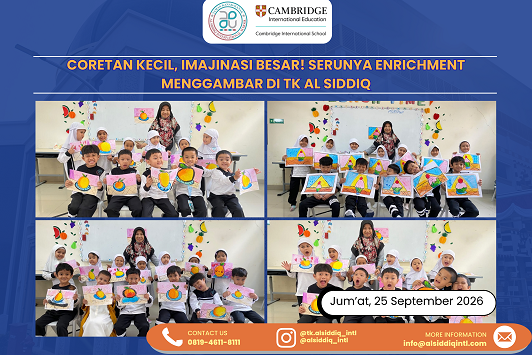
Little Strokes, Big Imagination! The Fun of Drawing Enrichment at TK Al Siddiq International

On Friday, 25 September 2026, students of TK Al Siddiq International took part in a Drawing Enrichment Activity held in the dining room. The activity provided a joyful opportunity for the children to learn and express themselves through art. Using simple drawing materials, the children were encouraged to turn their ideas and imagination into creative works.The school day began as usual at 8.00 a.m. and continued until 10.30 a.m. The children started their morning with Duha Prayer, held from 8.00 to 8.30 a.m. The Drawing Enrichment activity then continued in two sessions. The first session was for TK B students from 8.30 to 9.30 a.m., followed by the TK A session from 9.30 to 10.30 a.m.While waiting for the activity and the transition between sessions, the children continued with their usual school routines, such as journaling and snack time. These routines gave the children an opportunity to rest, enjoy their snacks, and prepare themselves for the drawing activity.During the TK B session, the children were invited to draw an ice cream with a cherry on top. Using crayons, they began creating the shape of the ice cream on paper and then added a cherry as part of their drawings. The children were free to explore different shapes and colours according to their creativity, making each artwork unique and full of character.Meanwhile, during the TK A session, the children were invited to draw an orange. Just like the TK B session, the children used crayons as their drawing tool and created their artwork on paper. Through this activity, they learnt to recognise shapes while expressing their observations through simple and enjoyable drawings.Drawing provides various benefits for early childhood development. As children hold and use crayons, they develop their fine motor skills and hand-eye coordination. They also learn to control their hand movements as they draw lines, create shapes, and add colour to their pictures. In addition, drawing activities can help children develop focus and patience as they work towards completing their creations.Drawing is not only about developing skills; it also provides children with space to nurture their creativity and imagination. The Drawing Enrichment activity at TK Al Siddiq International is one of the activities that allows children to learn through enjoyable experiences. With just a crayon and a sheet of paper, children can create meaningful artwork while developing important skills during their early years.Today’s little strokes can become part of a much bigger journey of learning, creating, and growing in confidence. By Inka Amalia, S.Pd

Kegiatan, SD

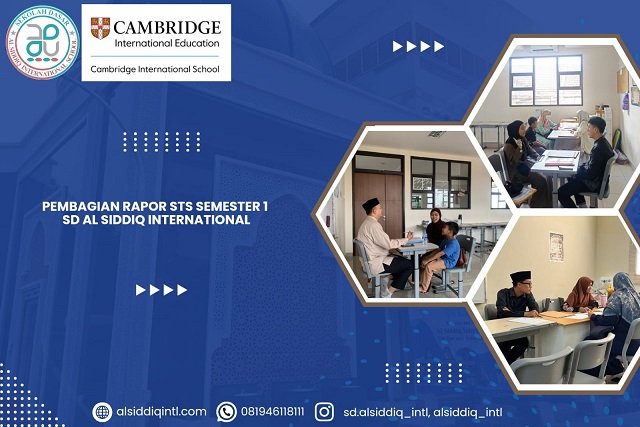
STS Report Card Distribution for Semester 1: Strengthening Collaboration Between School and Parents

On Friday, 25 September 2026, SD Al Siddiq International held the STS (Sumative Mid-Term Assessment) Report Card Distribution for Semester 1. The activity took place from 7.30 a.m. to 11.00 a.m. and served as an important moment in the students’ learning journey. It also provided an opportunity for communication between the school and parents to discuss students’ learning progress and achievements throughout the learning process.The report card distribution was conducted as a means of communicating the results of the learning evaluation carried out during the first half of Semester 1. Through the report cards, parents received information about their children’s academic development, attitudes, skills, and various achievements demonstrated during their learning activities at school.The activity took place in an orderly and warm atmosphere. Parents came to school to receive their children’s evaluation results and gain further information from teachers regarding their individual development. During the meeting, teachers shared various aspects of the students’ learning process, including achievements that had been attained as well as areas that still needed further development.For SD Al Siddiq International, report cards are not merely documents containing academic grades. They are part of the evaluation and reflection process that helps the school, teachers, and parents gain a more comprehensive understanding of each student’s development. Every child has a different learning journey and pace of development, so the evaluation results are expected to serve as a basis for providing guidance according to each student’s individual needs.The report card distribution also provided an opportunity to strengthen collaboration between the school and parents. Effective communication between teachers and parents plays an important role in supporting children’s education. Through continued cooperation, students’ potential and achievements can be further developed, while areas that still need improvement can be supported and addressed together.Beyond evaluation, the report card distribution also encouraged students to reflect on their own learning journey. Every achievement is the result of a process involving effort, discipline, and perseverance. Meanwhile, areas that still need improvement can serve as motivation for students to continue learning, making greater efforts, and growing in their future learning experiences.SD Al Siddiq International remains committed to providing an education that focuses not only on academic achievement, but also on character development and the holistic growth of every student. Therefore, learning evaluation results are expected to become part of a continuous process that helps each student grow into a confident, independent, responsible individual with a strong enthusiasm for learning.With the successful implementation of the STS Semester 1 Report Card Distribution on Friday, 25 September 2026, from 7.30 a.m. to 11.00 a.m., it is hoped that communication between the school and parents will continue to grow stronger. May the evaluation results received serve as both a source of reflection and motivation for students to strengthen their enthusiasm for learning and give their best effort in the next stage of their educational journey.Together, we support, guide, and inspire every child to grow.SD Al Siddiq International — Growing Together, Learning for the Future.By Muslihatul Maula, Lc

Kegiatan, SMP, Uncategorized

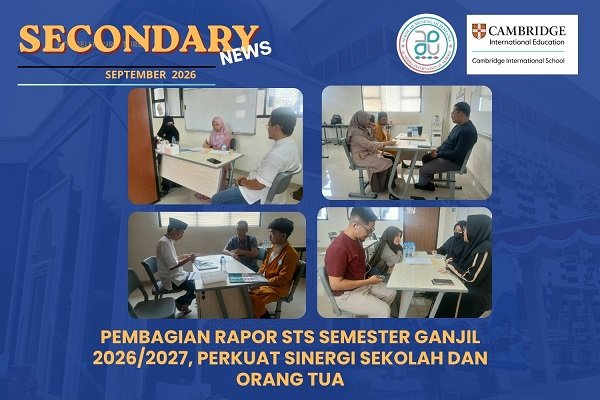
STS Report Card Distribution for the First Semester of 2026/2027: Strengthening Synergy Between School and Parents

Bekasi, 25 September 2026 — SMP Al-Siddiq International held the Sumative Mid-Term Assessment (STS) Report Card Distribution for the First Semester of the 2026/2027 Academic Year on Friday, 25 September 2026. This activity served as an important part of the evaluation process and communication of learning outcomes between the school, students, and parents or guardians.The distribution of STS report cards was not merely a moment to communicate students’ academic achievements, but also provided an opportunity for teachers and parents to discuss and better understand their children’s competency development, character, and learning progress throughout their time at school.From the morning, parents and guardians were warmly welcomed by the school. The meeting served as a bridge for building stronger communication and synergy between the school and families. Through effective communication, the school hopes that parents will continue to provide guidance, motivation, and attention to their children’s learning development at home.The report card distribution took place in an orderly, smooth, and enthusiastic atmosphere. Parents received information about their children’s learning outcomes while also having the opportunity to discuss their development and learning needs with teachers.The implementation of the STS and the distribution of report cards are part of SMP Al-Siddiq International’s commitment to fulfilling the school’s vision:“To become a globally minded Islamic school that develops a Qur’anic generation with strong knowledge of science and technology, an entrepreneurial spirit, and a commitment to protecting the environment.” Therefore, the learning outcomes presented in the report cards are not viewed merely as numbers or academic achievements, but as a broader reflection of each student’s overall development. The school continues to strive to nurture students’ potential so that they not only achieve strong academic results, but also develop noble character, independence, creativity, critical thinking skills, leadership qualities, and environmental awareness.The STS report card distribution for the First Semester of the 2026/2027 Academic Year served as an opportunity for reflection between the school and parents. The achievements attained are both an appreciation of students’ efforts and a foundation for making improvements and strengthening the learning process in the future.Through continuous synergy between the school, teachers, parents, and students, SMP Al-Siddiq International remains committed to providing globally minded Islamic education that prepares a generation that is Qur’anic, knowledgeable, well-rounded, creative, independent, and ready to face the challenges of the future.By Retno Suzanne Handayani, Lc, M.Pd