Al Siddiq International School

September 30, 2026

Kegiatan, TK

Learning Hijaiyah Letters through the Nuroniyah Method at the Qur’an Centre

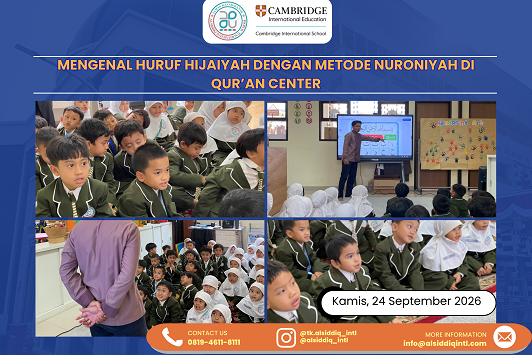
On Thursday, 24 September 2026, students of TK Al Siddiq International took part in a Qur’an learning activity at the Qur’an Centre. On this occasion, the children were introduced to the Hijaiyah letters through the Nuroniyah method. This activity formed part of the Qur’an learning programme provided for the children in an enjoyable environment appropriate to their stage of development, particularly within the learning programme at Al Siddiq International. Before beginning the Nuroniyah session, the children followed their usual morning routine. The day began with lining up, followed by journaling. Afterwards, the children performed Duha prayer together. These routines form part of the children’s daily habits, helping them begin their school activities in an orderly manner while introducing Islamic values into their everyday routines. After the Duha prayer, the children were given some time to play before moving on to the next activity. Following playtime, they had snack time, followed by toilet time. Once all the morning routines had been completed, the children prepared to take part in the Nuroniyah learning session together at the Qur’an Centre. The Nuroniyah session was led by Ustadz Mudzakky, the Qur’an teacher at TK Al Siddiq International. During the session, the children were introduced to the Hijaiyah letters as a foundation for learning to read the Qur’an. The Nuroniyah method is one approach to learning Qur’anic reading that is structured progressively, beginning with recognising the Hijaiyah letters and learning how to pronounce them correctly, including paying attention to the makharijul huruf, or the points of articulation of the letters. Learning the Hijaiyah letters through the Nuroniyah method does not focus solely on the children’s ability to recognise the shapes of the letters. They are also guided to understand and pronounce each letter correctly. As learning progresses, the material can gradually move from individual letters to connected letters, followed by an introduction to harakat and other forms of Qur’anic reading. Through these stages, children can develop a stronger foundation before learning to read sequences of Qur’anic verses. Through this activity, the students of TK Al Siddiq International were not only learning to recognise Hijaiyah letters but were also beginning to build a closer relationship with the Qur’an from an early age. Learning took place collectively under the guidance of the teacher, allowing the children to follow examples of pronunciation, listen carefully, and practise saying the letters they were learning. The Qur’an Centre therefore provided a welcoming space where children could learn about the Qur’an in a fun and engaging way. The introduction to Hijaiyah letters through the Nuroniyah method is expected to serve as an important first step in developing the children’s ability to read the Qur’an. Through learning that is carried out gradually and consistently, the children can become increasingly familiar with the Hijaiyah letters, develop accurate pronunciation, and nurture a love for and closer connection with the Qur’an from an early age.By Inka Amalia, S.Pd
Kegiatan, SMP

SMP Al-Siddiq International Holds Digital STS for the First Semester of 2026/2027, Integrating Cambridge and Islamic Education

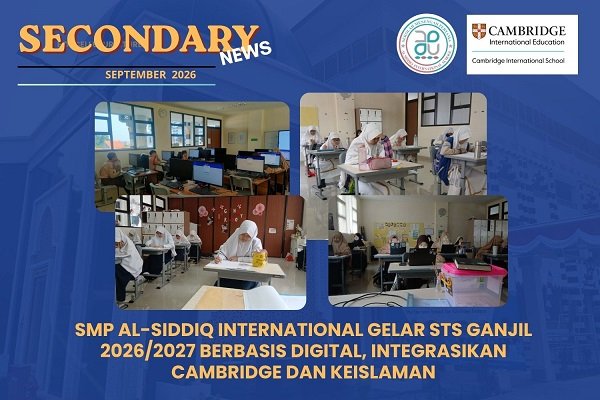
Bekasi, 21 September 2026 — SMP Al-Siddiq International conducted the Mid-Semester Summative Assessment (Sumatif Tengah Semester/STS) for the First Semester of the 2026/2027 Academic Year from 14–21 September 2026. The assessment was attended by all students according to their respective year groups and was conducted using a Learning Management System (LMS), while integrating English in Cambridge-based subjects and Arabic in Islamic education. The STS is an important part of the learning evaluation process, designed to measure students’ competency attainment at the midpoint of the semester. Rather than assessing academic knowledge alone, the assessment programme was also designed to strengthen students’ digital skills, language abilities, and Islamic values. Digital Assessment: Developing Students’ Technological Skills Unlike traditional examinations that rely entirely on printed question papers, this year’s STS at SMP Al-Siddiq International was conducted digitally through the Learning Management System (LMS). Students completed their assessments using the system prepared by the school. This approach forms part of the school’s efforts to familiarise students with the use of technology in academic activities, while encouraging them to become more independent, organised, and responsible throughout the assessment process. The use of technology also supports the educational approach of SMP Al-Siddiq International, which combines the development of knowledge and technological skills with Islamic education. English for Cambridge, Arabic for Islamic Education The integration of a global perspective was also evident throughout the STS. In Cambridge-based subjects, students completed their assessments using English. The use of English helps students become accustomed to learning materials and assessment instructions within an international education context. Meanwhile, Arabic was used in Islamic education subjects as part of the effort to strengthen students’ ability to understand Islamic terminology, learning materials, and Islamic sources. Through this approach, the assessment process serves not only as a means of measuring learning outcomes but also as an opportunity to develop students’ language skills and broaden their knowledge and understanding. STS Goes Beyond Written Assessments One of the distinctive features of the STS at SMP Al-Siddiq International is the inclusion of an oral BBQ (Bimbingan Baca Qur’an) assessment as part of the overall evaluation programme. The oral BBQ assessment focused on the memorisation of selected Qur’anic surahs. This assessment complemented the academic evaluation by incorporating aspects of spiritual development and Islamic character. Through this evaluation, the school seeks to ensure that education is not focused solely on cognitive abilities but also provides opportunities to strengthen students’ relationship with the Qur’an, spirituality, and Islamic character. Measuring Achievement, Building Character Throughout the STS, all students participated in the assessment programme in an orderly and conscientious manner. Teachers and the organising committee also worked to ensure that the entire process was conducted in accordance with the established procedures. Parental support was also an important part of creating a conducive learning environment during the STS. Collaboration between the school and families is expected to help students prepare themselves effectively, both academically and in terms of character development. Overall, the First Semester STS for the 2026/2027 Academic Year was conducted smoothly, orderly, and in a conducive atmosphere. For SMP Al-Siddiq International, the STS is not simply an opportunity to measure students’ academic results. More importantly, it forms part of the school’s educational process in developing a generation capable of integrating knowledge, technology, language skills, the Qur’an, and Islamic character. Through this integration, the school continues to work towards its vision: “To become a globally minded Islamic school that develops a Qur’anic generation with strong knowledge of science and technology, an entrepreneurial spirit, and a commitment to protecting the environment.” The STS programme is expected to serve as a valuable opportunity for students, teachers, and parents to reflect on the progress that has been achieved, while identifying areas for improvement and preparing for the next stage of the learning process.Retno Suzanne handayani, Lc, M.Pd