Al Siddiq International School

TK

Kegiatan, TK

Project-Based Learning (PJBL) Activity: “Maket House” at Al Siddiq International Kindergarten

The Project-Based Learning (PJBL) activity entitled “Maket House” was carried out by the children of TK A and TK B Al Siddiq International from Tuesday to Friday, 30 September – 1 October 2025. The activity took place in each classroom as part of thematic learning under the topic “My Environment”. Through the PJBL approach, the children were encouraged to learn actively and meaningfully by creating simple house models that reflected their understanding of their living environment. The main objective of this activity was to help children develop an understanding of the elements found in their surroundings, such as houses, fences, roads, trees, and yards. In addition, the activity aimed to enhance fine motor skills, cooperation, communication, and creativity as the children designed and decorated their own house models. By directly handling various materials and tools, they were able to learn in a fun, explorative, and practical way. For the TK B group, the project began on Tuesday with making houses, windows, and doors using recycled materials and craft tools. On Wednesday, they continued by creating roofs, fences, and trees. Thursday was dedicated to making roads and arranging the layout of the houses on cardboard as the base of the model. Friday served as the finishing day, where the children presented their completed projects to their teachers and classmates. Meanwhile, the TK A group started their project on Tuesday by making house walls using ice cream sticks assembled together. On Wednesday, they continued with the construction of simple roofs. On Thursday, the children added fences and grass decorations to beautify their models. Like the TK B group, Friday was dedicated to completing and presenting their finished work. The “Maket House” PJBL activity provided a joyful and meaningful learning experience for the children. They not only learned to recognise parts of a house and their surrounding environment but were also trained to think creatively, solve problems, and collaborate in groups. By engaging cognitive, socio-emotional, and motor aspects, this PJBL activity became an essential part of supporting the holistic development of early childhood learners at TK Al Siddiq International.By Inka Amalia, S.Pd

Kegiatan, TK

Visitation Activity of Al Siddiq International Kindergarten by Assessors from BAN-PDM

The visitation activity by assessors from the National Accreditation Board for Early Childhood Education and Non-Formal Education (BAN-PDM) was conducted at TK Al Siddiq International on Monday, 29 September 2025. The event took place at the Al Siddiq International School building and involved all key elements of the school community, including the headteacher, teachers, the school committee, education supervisors, and representatives from the Early Childhood Teachers Association (IGTK). This visitation was part of the assessment and accreditation process aimed at ensuring the quality of education in early childhood institutions. The main purpose of this visitation was to directly evaluate various aspects of educational implementation at TK Al Siddiq International — from planning to classroom instruction. Through this process, BAN-PDM assessors were able to observe how well the institution meets the national standards for early childhood education, while also providing constructive feedback for quality improvement. The assessors were responsible for verifying the data previously submitted by the school and ensuring that the documentation aligned with actual practices observed in the field. The activity began at 7:00 a.m. with a review of the daily lesson planning documents prepared by the teachers. From 8:00 to 11:00 a.m., the assessors conducted classroom observations to monitor the teaching and learning process. On that day, students participated in Art, Literacy, and Science lessons, showcasing the school’s application of thematic and interactive learning methods. Following the classroom observations, from 11:30 a.m. to 12:00 noon, the school held a brief welcoming ceremony attended by the headteacher, school director, teachers, the school committee, education supervisors, and IGTK representatives. As a gesture of appreciation and respect, the school presented the assessors with symbolic souvenirs. The session was followed by a break for prayers and lunch from 12:00 to 1:15 p.m. The visitation resumed at 1:15 p.m. with an interview session between the assessors and the teachers, lasting until 4:00 p.m. During this session, the assessors gathered in-depth information regarding teaching practices, challenges faced by teachers, and innovations implemented within the classroom. From 4:00 to 5:00 p.m., the assessors presented their findings, provided feedback, and officially concluded the visitation. The entire activity ran smoothly, warmly, and with a strong spirit of collaboration between the school and the assessors — reflecting TK Al Siddiq International’s commitment to maintaining and enhancing the quality of early childhood education.By Inka Amalia, S.Pd

Kegiatan, TK

Introducing Coding Concepts through Colours and Vowels

On Tuesday, 23 September 2025, the Kindergarten A pupils of Al Siddiq International took part in an engaging Literacy class activity that introduced them to the basic concepts of coding. This activity was specially designed to present the fundamentals of programming in a simple and enjoyable way, by linking colours with vowel letters. The children learned to recognise patterns, establish connections between symbols (vowels) and specific colours, and complete structured instructions. The session began with the teacher distributing worksheets containing a series of vowel letters (a, i, u, e, o) to each child. Each vowel was assigned a specific colour code — for example, the letter “a” was coloured red, “i” blue, and so on. The teacher then explained the process step by step, using easy-to-understand examples. The children were encouraged to identify the letters, match them with the corresponding colour, and colour them in according to the code. After the explanation and demonstration, the teacher gave the children full independence to work on their worksheets. This stage helped develop independence, memory skills, and the ability to follow instructions autonomously. The children appeared enthusiastic and focused as they worked, even discussing with one another to make sure the colours they chose matched the correct vowel letters. Introducing the concept of coding from an early age offers many valuable benefits. One key advantage is developing logical and systematic thinking, which forms the foundation of problem-solving skills. The children also learned to recognise patterns and symbols while strengthening their early literacy skills in a fun way. Furthermore, such activities enhance concentration and self-confidence as children complete tasks independently. Overall, this activity of introducing coding through colours and vowels not only broadened the children’s knowledge but also laid an early foundation for essential 21st-century skills such as critical thinking, collaboration, and technological literacy. It served as a joyful first step in exploring the digital world through an age-appropriate and creative approach.By Inka Amalia, S.Pd

Kegiatan, TK

Capturing Family Moments through Frame-Making

On Monday, 22 September 2025, the Kindergarten A pupils of Al Siddiq International enjoyed a fun and meaningful Art & Creativity lesson — making family photo frames. The activity took place in the Art Room, guided by both the class teacher and the art teacher. The children appeared enthusiastic as they followed each step of the process. The session began with the distribution of a sheet of paper featuring a picture of a house for each child. This paper served as the base for the photo frame they were going to create. The children were then asked to colour the picture of the house according to their own creativity. This colouring activity not only helped develop their fine motor skills but also provided a medium for them to express their imagination and emotions about the concept of “home.” After colouring, the teacher guided the children in cutting and folding specific parts of the paper. These folds were designed to form a frame resembling a house, where the family photo would later be placed. The children were visibly excited as they watched their work begin to take shape like a real photo frame. The final step was to attach their family photo inside the completed frame. The teacher had prepared each child’s photo in advance, collected earlier from their parents. With great pride, the children carefully placed their family photos into the frames they had decorated and assembled themselves. This moment became deeply personal and touching, as they could see their own family captured within a piece of art they had created. The purpose of this activity was to foster a sense of love and closeness towards their immediate family. Through it, the children were encouraged to recognise and appreciate their family members while understanding that family is the first place where they learn, grow, and feel safe. Additionally, the activity helped strengthen hand-eye coordination, introduced shapes and colours, and enhanced their ability to follow step-by-step instructions. Overall, the family photo frame-making activity was both enjoyable and educational. Beyond producing a creative artwork to take home, the children also learned to appreciate the important role their family plays in their everyday lives.By Umair Shoddiq, S.I.Kom

Kegiatan, TK

Role Play in Kindergarten Literacy Learning

On Wednesday, 30 October 2024, the Kindergarten students of Al Siddiq International School participated in a literacy learning activity using the Role Play method in the classroom, with the theme “My Family.” The activity began with a recall session on family members that the children had previously learned. The teacher then introduced simple English sentences such as “Who is he/she/they?” and “He is/She is/They are.” This method helped the children understand basic family concepts while also practising their English language skills in an interactive and engaging way. The role play began with one student asking another, “Who is he?” The student being asked then responded with a simple answer such as, “He is Brother.” The activity continued in turns until every student had the opportunity to both ask and answer questions, allowing them to practise listening and speaking skills in a fun, contextual setting. Through this interactive activity, the children not only learned to recognise family members but also developed their communication abilities and teamwork with their peers. This made the session an effective approach for enhancing both literacy development and social skills in young learners. By Inka Amalia, S.Pd

Kegiatan, TK

Assembling Puzzles in Literacy Learning

On Wednesday, 2 October 2024, the kindergarten students of Al Siddiq International School took part in a literacy lesson that involved assembling puzzles in groups within the classroom. The main goal of this activity was to train teamwork and communication skills among the students. Group learning allows children to share ideas, work together to complete tasks, and develop their social abilities from an early age. The activity began with a dancing session as a warm-up to create a cheerful atmosphere and boost the students’ enthusiasm. After that, the teacher conducted a review of the previous week’s lesson to help the children recall what they had learned. Next, the students were divided into small groups and given puzzles to assemble collaboratively, with each group member taking an active role in completing the challenge.By Inka Amalia, S.Pd

Kegiatan, TK

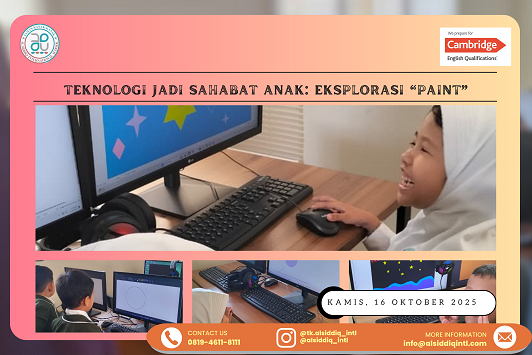
Developing Mouse Skills in ICT Class

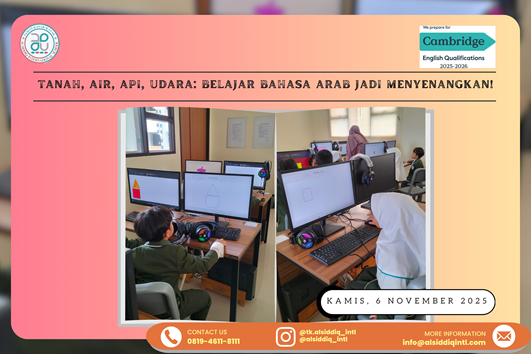
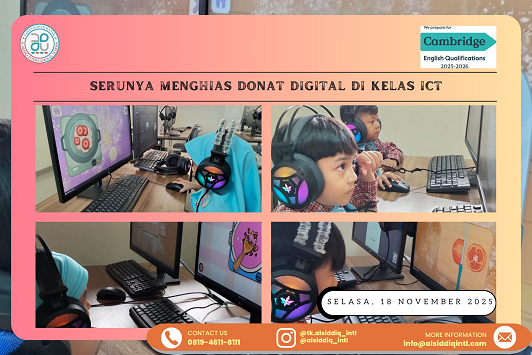
On Tuesday, 1 October 2024, the kindergarten pupils of Al Siddiq International School took part in an engaging ICT (Information and Computer Technology) lesson held in the school’s computer laboratory. The activity aimed to strengthen their fine motor skills, particularly in holding and moving the mouse. Under the teacher’s guidance, pupils were introduced to the basics of computer use through various interactive games designed to improve hand–eye coordination. Upon arriving at the lab, the pupils enthusiastically turned on their own computers—an ability they had previously learned. They then began playing educational games that were not only entertaining but also helped them develop better mouse control. This lesson was expected to enhance their basic ICT skills while providing an enjoyable learning experience. ICT sessions are conducted for only 30 minutes each week. Inka Amalia, S.Pd

Kegiatan, TK

Gamification Programme Awards at Al Siddiq Kindergarten

On Monday, 23 September 2024, following the regular flag-raising ceremony, the kindergarten pupils of Al Siddiq International School received recognition in the “Bilingual Gamification Programme for August 2024.” The event took place in the school courtyard and served as an appreciation for students who demonstrated active communication skills in both English and Arabic while at school. The award recipients were Abraham (K2), Reno (K1A1), and Queeisha (K1A2), who stood out for their enthusiasm and consistency in using both languages during school activities. The main purpose of this award is to motivate pupils to be more enthusiastic in using English and Arabic in their daily school life. Through this recognition, educators aim to foster a learning environment that supports bilingual development from an early age, helping children become more confident and proficient communicators. By Inka Amalia, S.Pd

Kegiatan, TK

Al Siddiq Kindergarten Students Create Beaded Bracelets

On Thursday, 19 September 2024, the students of Al Siddiq Kindergarten took part in a beading activity as part of their Project-Based Learning (PjBL) programme. This activity was designed to provide a fun and interactive learning experience, allowing the children to learn through play. Under the guidance of their teachers, the students eagerly selected and arranged colourful beads to create their very own handmade bracelets. The beading activity aimed to develop students’ fine motor skills, while also enhancing their creativity, patience, and focus. Through this task, the children were encouraged to concentrate carefully, as creating a bracelet requires precision and attention to detail. In addition, the activity helped them recognise different colours and shapes, improve hand–eye coordination, and build patience, as each bracelet was completed through several thoughtful steps. The teachers provided clear and enjoyable instructions, ensuring that every child could easily follow along and enjoy the process. Once finished, the students proudly displayed their beautiful bracelets to their classmates. The bracelets they created were not only a symbol of creativity but also a reflection of their effort, perseverance, and sense of achievement. Through this activity, it is hoped that the students will not only gain practical skills but also develop greater confidence and appreciation for their own work.By Inka Amalia, S.Pd

Kegiatan, TK

Al-Siddiq Kindergarten Students Learn About the Birth of Prophet Muhammad S.A.W

On Tuesday, 17 September 2024, in learning and reflecting upon the story of the Birth of Prophet Muhammad S.A.W, Al-Siddiq International Kindergarten held a Storytelling Session to commemorate the Maulid Nabi 1446 Hijri. The session was delivered by Ustadz Fachrizza Mudzakky, S.H., Al-Hafidz, who serves as the Qur’an teacher at Al-Siddiq Kindergarten. The event was filled with great enthusiasm and excitement as the pupils listened attentively to inspiring stories about the life of the Prophet. They were introduced to key moments surrounding the Prophet’s birth — such as the arrival of the army of elephants that intended to destroy the Ka’bah, but by Allah’s will, the birds of Ababil came carrying stones of fire to protect it, as well as the introduction to the family members of Prophet Muhammad S.A.W. The activity took place in the Al-Siddiq International School Mosque after the pupils had performed Dhuha prayer together. It was held to instil love for Prophet Muhammad S.A.W in the hearts of the children from an early age. Through the storytelling, which was delivered in a simple and engaging way suited to young learners, the main aim was to help them become more familiar with the Prophet — a role model for all Muslims. In addition, it is hoped that through this celebration, the children will be inspired to emulate the values of kindness, compassion, and leadership exemplified by the Prophet Muhammad S.A.W.By Inka Amalia, S.Pd

Kegiatan, TK

Class and School Tour

On Tuesday, 16 July 2024, Al-Siddiq Kindergarten held a Class and School Tour activity as part of the School Environment Introduction Programme (MPLS). During the Class and School Tour, the pupils were invited to explore various school facilities such as the Indoor Playground, Library, Science Laboratory, Computer Laboratory, Canteen, and Mini Garden. The activity, which lasted for approximately one hour, aimed to provide pupils with a refreshing experience outside the classroom and serve as an opportunity for them to explore their curiosity about the facilities and environment of Al-Siddiq School.By Inka Amalia, S.Pd

Kegiatan, TK

School Orientation Week at Al Siddiq Kindergarten

The School Orientation Week (MPLS) is a regular annual programme conducted by Al Siddiq Kindergarten at the beginning of every new academic year. This activity marks an important first step for children as they begin their journey into formal education. As part of the MPLS programme, Al Siddiq Kindergarten introduces pupils to the school environment while instilling Islamic daily routines such as muroja’ah (Qur’an recitation), performing Dhuha prayers together, and practising Nuroniyyah reading. The MPLS programme at Al Siddiq Kindergarten runs for two weeks, featuring a variety of engaging activities including School Tour, Storytelling, Sensory Play Activities, Toilet Training, and concluding with a delightful Mini Picnic. Through this series of activities, it is hoped that students will gain a sense of confidence and security, helping them to adapt smoothly and enthusiastically to the upcoming teaching and learning process.By Inka Amalia, S.Pd