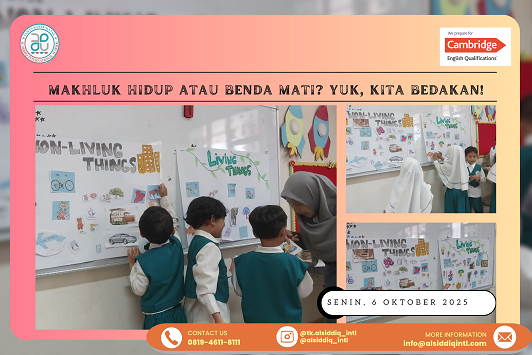
On Monday, 6 October 2025, the children of TK B at Al Siddiq International School took part in a Living Things and Non-Living Things classification activity during their Literacy class. This activity was part of the ongoing thematic learning programme, designed to introduce basic scientific concepts to young learners through enjoyable and practical experiences.
The activity was conducted in a simple yet meaningful way. The children were given several printed pictures featuring living things, such as animals and plants, as well as non-living things, such as cars, stones, and balls. Using scissors, the children were asked to cut out the pictures and then stick them onto a large sheet of card that had been divided into two columns: Living Things and Non-Living Things.
The aim of this activity was to train logical thinking and categorisation skills from an early age. The children learned to distinguish the characteristics of living things—such as being able to move, grow, and need food—from non-living things that do not share those traits. The cutting and sticking process also helped develop their fine motor skills, concentration, and observation of the world around them.
This classification activity also served as a bridge between science and literacy learning. As the children named each object they pasted, they expanded their vocabulary and deepened their understanding of the concepts. The teacher guided light discussions, such as “Why is a cat a living thing?” or “Why can’t a table grow?”, to stimulate curiosity and critical thinking skills.
Through this activity, learning became both fun and meaningful. The children were not just sitting and listening but actively engaging—moving, choosing, cutting, and sticking—while understanding important everyday concepts. With this kind of approach, scientific knowledge is introduced from an early age in a joyful and memorable way.
By Inka Amalia, S.Pd