Al Siddiq International School

TK

Kegiatan, TK

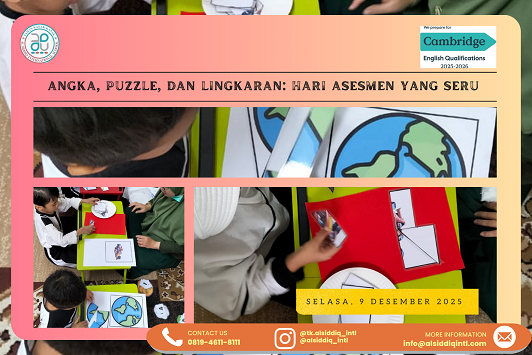
Numbers, Puzzles, and Circles: A Fun Assessment Day in TK B Al Siddiq

This mathematics assessment was designed to observe children’s basic understanding of numbers, patterns, sizes, and relationships between objects. The activities focused on abilities appropriate to the developmental stage of kindergarten children, particularly early numeracy skills and shape observation. The assessment was conducted in a simple manner so that the children felt comfortable and were able to demonstrate their abilities naturally. The participants in this activity were the students of TK B Al Siddiq. At this age, children are actively exploring their surroundings, so the assessment was made engaging and easy to follow. Each task was adjusted to suit their individual abilities, both for those who were already confident in counting and for those who still required visual support. The activity took place in the classroom, an environment that was already familiar to the children. This familiar setting helped them remain calm and focused. The classroom also allowed teachers to monitor each child closely and provide support whenever needed. The assessment was conducted on 9 December 2025. The choice of this date was aligned with the learning schedule so as not to disrupt other routines. With a clear timetable, teachers were able to prepare the materials, worksheets, and small-group arrangements to ensure the activity ran smoothly. The objectives of this assessment were linked to six areas of child development. First, cognitive development, including the ability to recognise numbers, distinguish sizes, and understand sequences. Second, fine motor development through activities such as writing numbers, drawing circles, and assembling puzzles. Third, language development, as children needed to understand instructions and, in some cases, explain their answers. Fourth, social development, shown when children waited for their turn and worked in small groups. Fifth, emotional development, which emerged as children learned to manage their confidence and patience. Sixth, moral development, reflected in orderly behaviour, taking turns, and completing tasks honestly. The assessment was carried out in stages. Teachers began by demonstrating how to complete the worksheets so that the children had a clear understanding of the tasks. While waiting to be called, the children worked on worksheets that included practising writing numbers from 1 to 20 and drawing circles according to the specified quantities. Every three children were then called to take part in the core assessment, which involved assembling puzzles and arranging objects from the smallest to the largest. This approach enabled teachers to observe each child’s abilities more closely without making them feel rushed. With this approach, the assessment was not merely an evaluation, but also an opportunity for children to learn and demonstrate their abilities in a positive and well-structured environment.By Inka Amalia, S.Pd
Kegiatan, TK

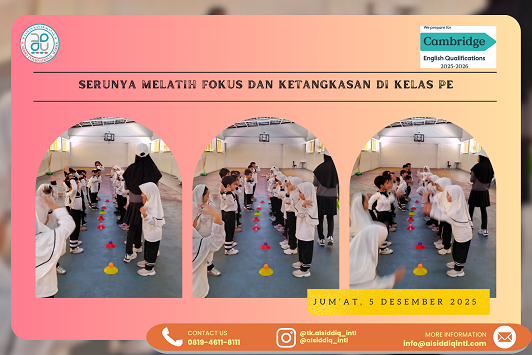
Exciting Activities to Build Focus and Agility in Physical Education Class

This Physical Education lesson was designed to train focus, agility, and the ability to follow instructions. The activities were kept simple yet engaging so that the children could move actively without feeling overwhelmed. These exercises provided opportunities for the children to play while learning to control their body movements. The participants were Kindergarten B pupils of Al Siddiq. Children at this age are energetic and enjoy small physical challenges, making games that involve quick movements and responsive actions highly suitable for them. With the right guidance, activities like these help them develop essential foundational skills. The activity took place at the Al Siddiq International indoor court on 5 December 2025. The spacious and safe area offered plenty of room for the children to move freely, jog, and respond to instructions without the risk of bumping into one another. The indoor setting also made the activities comfortable regardless of weather changes. The objectives of this activity were related to six aspects of child development. From the gross motor aspect, the children learned to run, bend, and move quickly while following instructions. From the fine-motor aspect, they learned to control hand movements when picking up the ball. From the cognitive aspect, they practised sorting instructions, remembering sequences, and responding quickly. From the social aspect, they worked in groups and learned to wait for their turn. Their language skills improved as they listened to and understood the teacher’s commands. From the emotional and moral aspects, the children learned to manage their excitement, respect the rules, and keep the game fair and sportive. The session began with a focus and agility game. The teacher divided the children into two groups and prepared cones with tennis balls placed on top. The teacher gave instructions such as “touch your head”, “touch your shoulders”, “touch your feet”, and “take the ball”. The children had to listen attentively and move according to the cues. This activity trained them to focus on listening, avoid guessing movements, and follow instructions all the way through. With a simple yet structured flow, this Physical Education lesson became an opportunity for the children to stay active while learning focus, discipline, and teamwork. The children not only enjoyed the game, but also developed in various areas essential for their age.By Inka Amalia, S.Pd

Kegiatan, TK

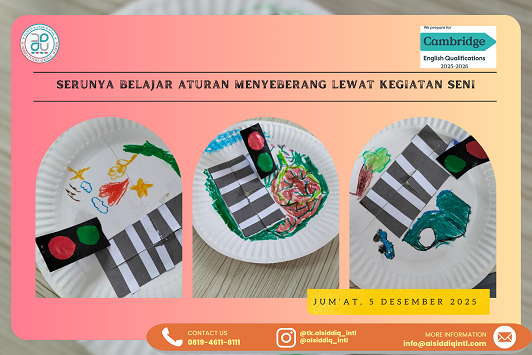
The Excitement of Learning Crossing Rules Through Art Activities

This Art & Creativity lesson combined artistic activities with learning about road safety when crossing the street. The children were not only creating artwork, but also understanding real-life situations that are familiar to them. In this way, art becomes a medium for learning important skills for everyday life. The participants of this activity were Kindergarten B pupils from Al Siddiq. At this developmental stage, they are imaginative and quick to absorb new information. Therefore, art activities connected to daily experiences help them link what they see, hear, and do. The activity took place in the classroom on 5 December 2025. The familiar environment made the children feel more comfortable exploring. A safe and well-organised space also made it easier for the teacher to prepare materials, play videos, and guide the children during the process of creating miniatures. The objectives of this activity were related to six developmental aspects. From the cognitive aspect, the children learned to compare safe and unsafe behaviours when crossing, and to identify important components such as zebra crossings and traffic lights. From the language aspect, they expressed their opinions, answered questions, and described differences shown in the videos. From the fine-motor aspect, they practised cutting, sticking, and assembling miniature pedestrian lights. From the social aspect, the children learned to discuss and work together with their friends. From the emotional aspect, they developed confidence when sharing their answers. From the moral aspect, they understood essential safety rules and learned how to apply them. The activity began with a trigger question from the teacher: “How should we cross the road?”. This question helped the children recall their own experiences. After that, the teacher played two videos showing responsible and careless behaviours when crossing the street. The children were asked to mention the differences. The teacher then invited them to name the components that must be considered when crossing, such as zebra crossings and pedestrian lights. To conclude, the teacher and children created 3D miniature pedestrian lights. This activity allowed the children to express their understanding through an art project. With this approach, the Art & Creativity lesson became a fun and meaningful experience. The children not only created something interesting, but also learned to understand their environment and how to keep themselves safe.By Inka Amalia, S.Pd

Kegiatan, TK

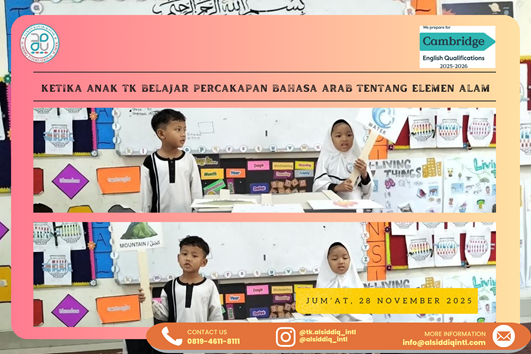
When Kindergarten Children Learn Arabic Conversations About Natural Elements

On Friday, 28 November 2025, the Kindergarten B pupils of Al Siddiq took part in an Arabic lesson on the theme of natural elements. The activity was held in the classroom in a relaxed and warm atmosphere. The children appeared curious because the material presented was different from their usual lessons. They were learning not only to memorise vocabulary, but also to understand its meaning through examples close to their daily lives. The teacher began the lesson by introducing four elements: water, earth, fire, and air. Each word was presented together with visual or real-life examples to help the children understand more easily. For instance, the element of water was explained using examples such as the sea and the river. The earth element was introduced through mountains and the forest area in the school yard. Fire was explained through the sun and lava, while air was illustrated through the wind and tornadoes. These explanations enabled the children to grasp the meaning of each element more quickly. The purpose of learning natural elements in Arabic was to help the children gain meaningful and relevant new vocabulary. By connecting the words to real objects, the learning process became more engaging and memorable. In addition, simple Arabic conversations helped build their confidence in speaking. The children were not only learning the vocabulary, but also how to use it. This learning approach strengthened their self-confidence as they tried to explain something in another language. After understanding the meanings and examples, the teacher began teaching how to describe these elements in Arabic. The teacher recited simple sentences, and the children repeated them together. This moment was always full of enthusiasm as the children eagerly competed to pronounce the words correctly. Once all the pupils were considered confident, the teacher invited them to come to the front of the class. One by one, the children mentioned the natural elements in Arabic and explained them in simple sentences. Some children appeared nervous, but with the teacher’s support, they began to speak bravely. This activity concluded the lesson in a joyful way. The children went home with a new experience—realising that learning a language does not have to be difficult, as long as it is taught in a way that connects with their world.By Inka Amalia, S. Pd

Kegiatan, SD, Sekolah, SMP, TK

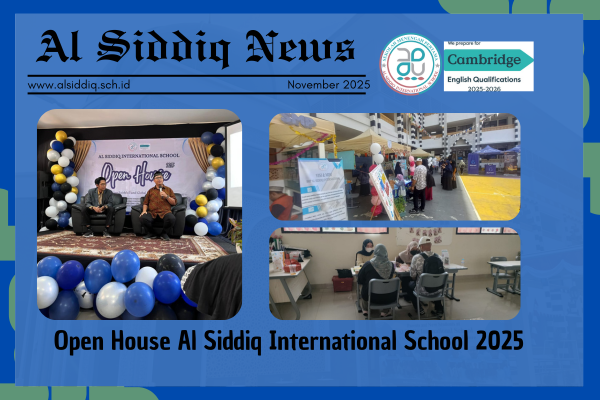
Open House Al Siddiq International School 2025: Education, Collaboration, and Service

On Saturday, 29 November 2025, Al Siddiq International School successfully held its Open House, an event filled with warmth, enthusiasm, and meaningful interaction. Starting at 08:00 WIB, the programme was attended by dozens of prospective parents eager to learn more about the school’s educational approach and learning environment. The event began with an insightful seminar entitled “Growth Mindset Insight”, delivered by growth mindset practitioner Dr Rachmat Hidayat (Doctor in Education Sciences).During the session, Dr Rachmat shared valuable perspectives on developing a growth mindset in children as a foundation for overcoming learning challenges. Parents responded enthusiastically, actively engaging and appreciating the content presented. Following the seminar, prospective parents were invited to visit the stands representing the Early Years (TK), Primary (SD), and Secondary (SMP) units.Each stand showcased: Comprehensive information about each unit’s profile and curriculum, Documentation of learning activities that had taken place, Exhibitions of student-made products and creative works, from early years projects and primary school portfolios to innovative and project-based creations from secondary students, The stands were designed to be interactive and informative, offering visitors a direct look at the learning process and student achievements at Al Siddiq International School. Adding extra value to this year’s event, the school collaborated with the Masmitra Hospital Team (RS Masmitra Bekasi) to provide free health check-ups for all attending parents. The service included basic health screenings and short consultations, which were warmly welcomed by visitors. This initiative reflects the school’s commitment to supporting the well-being of the Al Siddiq community. The atmosphere of the Open House was further enlivened by a food bazaar offering a variety of culinary options. The bazaar became a pleasant gathering spot where parents could enjoy light refreshments after touring the stands and participating in the programme. Throughout the event, parents demonstrated remarkable enthusiasm. They actively asked questions, engaged in discussions, and showed great interest in the school’s educational programmes. This strong involvement reflects the high level of trust the community places in Al Siddiq International School as a nurturing and forward-thinking learning institution. Through the 2025 Open House, Al Siddiq International School hopes to continue strengthening the relationship between the school and parents, while showcasing its commitment to innovative, inclusive, and future-oriented education.By Arief Firmansyah, S. Kom

Kegiatan, SD, SMP, TK

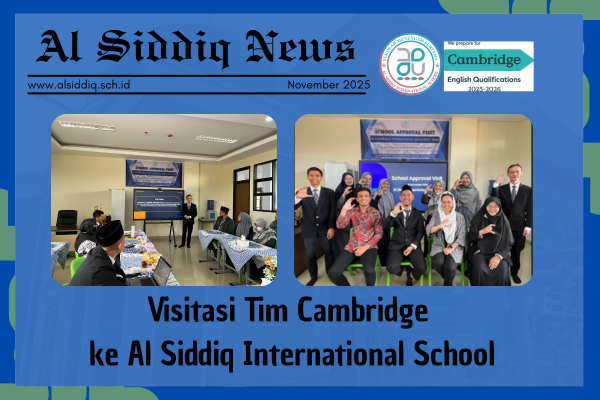
Cambridge Team Visit to Al Siddiq International School

On Wednesday, 26 November 2025, Al Siddiq International School welcomed an official visit from the Cambridge team as part of the school’s process of implementing the Cambridge curriculum. The visit was represented by Mr Dera Yornanda and Mrs Priska Imanuelle, who came to conduct observations, evaluations, and provide insights regarding the school’s readiness to adopt the international curriculum. The programme began with a presentation on the school profile delivered by Mr Fedrian Hasmand, M.Sas, representing Al Siddiq International School. In his presentation, he explained the school’s vision, mission, development milestones, learning facilities, and academic enhancement strategies aligned with Cambridge standards. This session offered the Cambridge representatives a clear overview of the school’s identity, character, and direction for future growth. After the presentation, the Cambridge team continued with teacher interviews involving : Mrs Robiah Adawaiyah, M.Pd, and Mrs Elsa Violita, S.S. M.S, During these interviews, the teachers shared their perspectives on the teaching and learning process, the methods they apply, and their experiences implementing competency-based approaches. The Cambridge team also explored their understanding of international curriculum implementation and their readiness to support a global learning environment. The visit proceeded with interviews involving two students, Omar and Celia. This session aimed to gain direct insight into how pupils experience learning at Al Siddiq International School. Both students shared their thoughts on classroom activities, subjects they enjoy, and how they interact with teachers and friends. Their honest, enthusiastic, and confident responses reflected the school’s supportive environment in developing both character and academic abilities. The Cambridge representatives were then taken on a school tour to observe the facilities that support the learning process. The tour included visits to classrooms, the library, laboratories, sports areas, and other supporting spaces. Throughout the tour, they observed how each facility was designed to create a safe, comfortable, and inspiring learning experience for pupils. The visit concluded with a feedback session delivered by Mrs Priska Imanuelle. She expressed appreciation for the school’s efforts in building a high-quality learning system. The Cambridge team also shared several development recommendations, which will serve as valuable guidance for strengthening the implementation of the Cambridge curriculum in the future. The Cambridge team’s visit marked an important milestone in Al Siddiq International School’s journey towards implementing an internationally recognised curriculum. Through a comprehensive series of activities—from presentations and interviews to observations and professional feedback—the school gained a clearer understanding of its strengths and areas for refinement.This visit not only enhanced academic quality but also reinforced the school’s commitment to providing excellent, modern, and globally competitive education. By Arief Firmansyah, S.Kom

Kegiatan, SD, SMP, TK

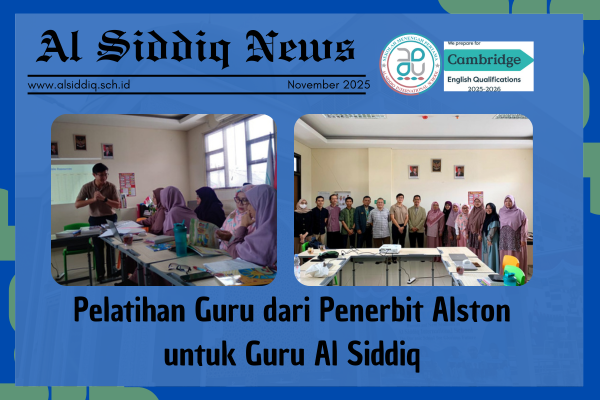
Training by Alston Publishing for Al Siddiq Teachers

On Thursday, 20 November 2025, the teachers of Al Siddiq International School took part in a special training session conducted by Alston Publishing. The training was held in the Headteacher’s Office and attended by teachers from various levels. This programme marked an important step in strengthening teaching quality and ensuring that educators continue to grow in line with curricular demands and pupils’ learning needs. Led directly by the team from Alston Publishing, the training aimed to provide professional guidance to teachers in understanding and optimising the use of textbooks and learning materials published by Alston. With well-structured content, the session equipped teachers with deeper insights into modern teaching strategies that align with the learning materials provided. Throughout the session, participants received explanations on textbook structure, learning flow, and effective ways to deliver material in the classroom. The Alston team also demonstrated examples of activity-based learning methods that help boost pupils’ motivation and engagement. Teachers were invited to discuss real classroom challenges and explore practical solutions that could be implemented in daily teaching. Beyond theory, the training included practical activities and case studies. Teachers were given the opportunity to design short lesson plans, practise delivering material, and receive direct feedback from the instructors. The discussions were lively and productive, reflecting the teachers’ enthusiasm for continuously developing their professional skills. Through this training, Al Siddiq International School reaffirmed its commitment to supporting the improvement of teacher competency. The collaboration with Alston Publishing is expected to further strengthen learning quality, create more interactive classroom environments, and enhance pupils’ learning experiences. The training held on 20 November 2025 not only provided fresh insights but also motivated teachers to innovate in their teaching methods. With continued support from various partners, including professional publishers like Alston, Al Siddiq International School remains confident in its mission to deliver excellent and relevant education for today’s learners. By Arief Firmansyah, S.Kom

Kegiatan, TK

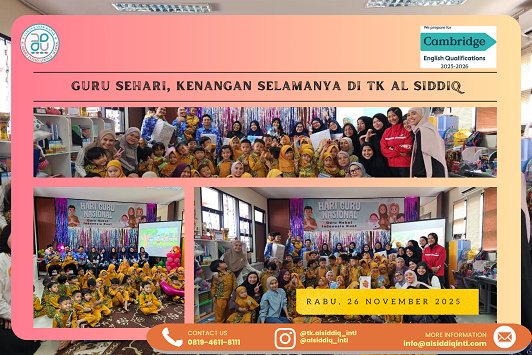
A Day as a Teacher, Memories for a Lifetime at Al Siddiq Kindergarten

On Wednesday, 26 November 2025, Al Siddiq Kindergarten held a Teachers’ Day celebration in the kindergarten classrooms. The event became a special moment for all pupils, teachers, and parents. The morning felt livelier as the children arrived earlier than usual. Many of them came to school at seven o’clock, looking enthusiastic and curious about the activities prepared for the day. At 7.30 a.m., the kindergarten children joined the pupils of Al Siddiq Primary and Secondary School for the Teachers’ Day ceremony, which lasted until eight o’clock. During the ceremony, the children were guided to appreciate the dedication of their teachers, who support and teach them every day. It was a simple yet meaningful moment, giving the children an opportunity to see that teachers’ roles are valued by many. After the ceremony, activities continued in the kindergarten classroom. This time, the leaders were the mothers or parents who took on the role of “teacher for a day”. The purpose of celebrating Teachers’ Day in this way was to allow parents to experience first-hand what it feels like to teach young children. Additionally, the children could see that learning does not only come from teachers at school but also from their parents, who play an important role too. This activity also served as a gesture of gratitude to the teachers for their patience and dedication in guiding the children. The theme of the day was professions. Some parents introduced their jobs to the children. One mother, who works as a flight attendant, explained her duties while working. The children were very excited to hear stories directly from someone who carries out the profession. They learnt about service, safety, and how flight attendants assist passengers during a flight. There was also a mother who is a professional Indonesian badminton athlete. She introduced the world of sports to the children in a simple and enjoyable way. The children were invited to hold a racket, learn the correct body posture, and try hitting a shuttlecock gently. Although most of the hits missed, they were visibly enthusiastic. This activity gave them an understanding that being an athlete requires training, discipline, and hard work, yet it can still be enjoyed with joy. After the profession introduction session, the children took part in a simple experiment using turmeric powder and vinegar. This activity allowed them to be hands-on and learn through exploration. The colour changes and reactions that occurred made them even more curious about the world of science. Although simple, the experiment offered a fun new experience that was easy for them to remember. The event concluded with a communal meal shared by teachers, parents, and children. The atmosphere was warm and full of laughter. This activity emphasised that a school is not only a place for learning but also a place to build strong relationships between families and teachers. Ultimately, this year’s Teachers’ Day celebration at Al Siddiq Kindergarten was not only about honouring teachers, but also about togetherness and mutual appreciation.By Inka Amalia, S.Pd

Kegiatan, TK

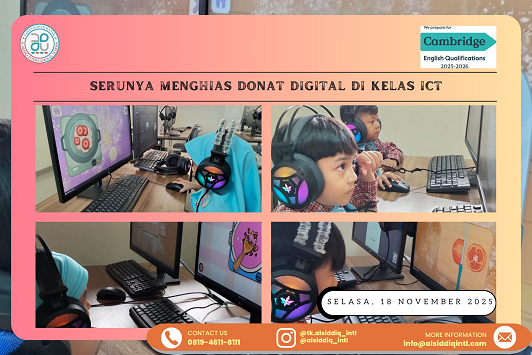
The Excitement of Decorating Digital Doughnuts in ICT Class

On Tuesday, 18 November 2025, the Nursery A pupils of Al Siddiq International took part in an ICT learning activity in the computer lab. The theme of the day was creating digital doughnuts. Although this activity seemed simple, it was designed to help children develop their hand skills while using a mouse. The teacher aimed for the children to become more familiar with moving the cursor, selecting elements, and clicking accurately. Upon arriving at the computer lab, the children immediately looked for their preferred seats and sat down neatly. Some appeared particularly enthusiastic, as the lab is one of their favourite rooms. The atmosphere quickly became lively as the monitors lit up and a blank doughnut image appeared on each computer screen. The teacher then gave step-by-step instructions. The children were asked to move the mouse to choose toppings, colours, and decorations available. Each element had to be selected with the correct click. The children began practising by slowly guiding the cursor. Some mastered it quickly, while others needed time to adjust their hand movements. During the decorating process, many delightful moments occurred. Some children chose bright colours, others added lots of sprinkles, and some paused for a moment when their cursor accidentally moved too far. The teacher accompanied them patiently, offering encouragement to help them stay confident. Each small attempt became an important exercise for developing their fine motor skills. This activity was not only about creating beautifully decorated doughnuts. The children learnt to control finger pressure, hold the mouse properly, and move their hands with good coordination. All of these skills support their readiness for future ICT activities that will require even greater precision. At the end of the session, the children proudly admired their artwork on the screen. The teacher gave them time to look at their friends’ doughnuts, sparking compliments and laughter. This simple activity ended their day with a fun and colourful learning experience.By Inka Amalia, S.Pd

Kegiatan, TK

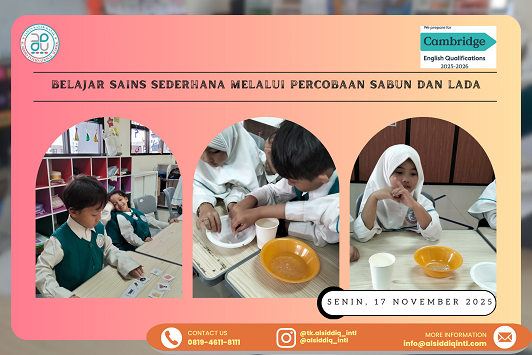
Learning Simple Science through a Soap and Pepper Experiment

On Monday, 17 November 2025, the TK B pupils of Al Siddiq International took part in a simple experiment in the Science and Maths classroom. The activity used everyday materials—water, pepper, soap, and cotton buds. Although it appeared simple, the experiment was designed to spark the children’s curiosity and encourage them to observe real reactions from the objects around them. Before starting the experiment, the teacher led a recall activity about different types of professions. The children were invited to mention jobs they knew, from teachers to scientists. From there, the teacher explained that scientists often conduct experiments to discover new things, including substances that help people remove bacteria from their hands when washing with soap. This explanation served as a bridge to the experiment they were about to carry out. The teacher then prepared a container of water sprinkled with pepper. The children were allowed to observe the pepper floating on the surface and to guess what would happen when soap was added. This moment brought the classroom to life as the children freely shared their predictions, whether amusing or logical. Each child received a cotton bud. The teacher demonstrated how to dip one end into the soap. The children then gently touched the surface of the pepper-covered water with their cotton buds. As soon as the tip touched the water, the pepper particles immediately moved away from the point of contact. The children looked surprised and delighted to see such a quick reaction. Through this experiment, the children learned that soap has the ability to break the surface tension of water, causing the pepper to move away. The explanation was given in simple terms to make it easy to understand. More importantly, the activity offered a hands-on experience that made the children feel like little scientists. They did not just hear the theory; they experienced the cause-and-effect process themselves. The activity ended their day with a sense of pride and curiosity. Many of them asked whether there were other experiments they could try. The teacher emphasised that curiosity is the first step to becoming a good learner. Through simple activities like this, the children learned that science can be found anywhere—even in the soap and pepper they have at home.By Inka Amalia, S.Pd

Kegiatan, TK

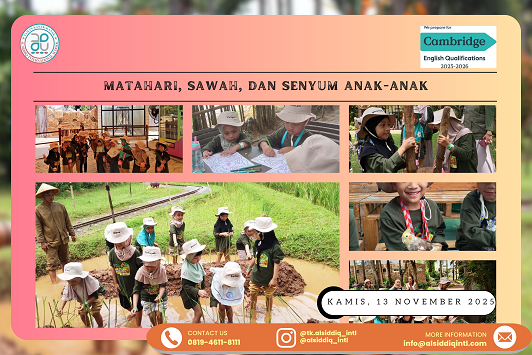
Sunshine, Rice Fields, and Children’s Smiles

On Thursday, 13 November 2025, TK Al Siddiq International carried out an Educational Field Trip (EFT) to Scientia Square Park (SQP) in Tangerang. This activity became one of the key moments in the early childhood learning process, where the children were invited to learn directly outside the classroom through real and enjoyable experiences. The field trip served not only as an educational activity, but also as an opportunity for exploration, social interaction, and character development. From as early as 07.00 WIB, the children had gathered at the departure point, Bella Vista. The activity began with initial documentation, a warm welcome from the Head of School, and a collective prayer for a smooth and blessed journey. During the trip to Scientia Square Park, the children did not simply sit quietly; instead, they filled the time by reciting murojaah together, allowing the activity to remain Islamic in atmosphere and full of meaning. Upon arrival, the children continued with further documentation, put on wristband tickets as identification, and were guided to organise their belongings. All students were then divided into two large groups to ensure the activities ran in a more orderly and structured manner. Each group took part in the same series of activities in different sequences. The programme began with an introduction to various types of birds and chickens, followed by observing unique animals such as alpacas. Direct interaction with these animals aimed to foster a sense of love for living creatures as well as developing empathy and courage. Next, the children participated in rice pounding and rice planting activities in the mini paddy field provided in SQP’s agricultural education area. The rice-pounding activity was intended to introduce the traditional process of preparing a staple food, as well as instilling appreciation for the food they consume every day. Meanwhile, planting rice gave them first-hand experience of the origins of food and the importance of caring for plants. By stepping directly into the paddy field, the children learned about responsibility, patience, and the natural cycle in a concrete way. The day concluded with a water-play session, which served as both recreation and a refreshing break after the entire series of educational activities. After cleaning up and changing clothes, the children prepared for the journey home. This EFT left a lasting impression on the children, teachers, and parents. It was not merely a trip, but an experience filled with meaningful educational value. It is hoped that through activities like this, the children of TK Al Siddiq International will grow into active individuals who care for the environment and have a strong sense of curiosity about the world around them.By Inka Amalia, S.Pd

Kegiatan, TK

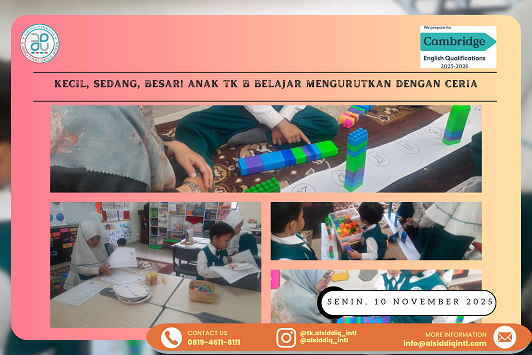
Small, Medium, Large! TK B Pupils Learn to Sequence with Joy

On Tuesday, 11 November 2025, the children of TK B at Al Siddiq International took part in a simple yet highly meaningful learning activity: arranging objects from smallest to largest. The activity took place in the Science and Maths classroom, which had been set up with a cheerful atmosphere and engaging visual aids. Although it may have looked like an ordinary game, this activity was designed to build the foundation of logical thinking, mathematics, and cognitive skills for young children. The main purpose of the activity was to introduce the concepts of sequencing, size, and comparing objects based on specific characteristics—in this case, size. For kindergarten pupils, the ability to sequence is an important part of developing logical thinking and problem-solving skills. The children learned that objects can be classified and arranged, and that everything has patterns and structure. This serves as a foundation for more complex mathematical understanding in the future. During the session, the teacher began by observing the children’s ability to add and count using LEGO blocks. This was intended to gauge their basic understanding of numbers and quantities. Meanwhile, while waiting for their turn, the children worked on an equally exciting worksheet prepared by the teacher: sequencing pictures of objects from small to large. Excitedly, the children picked up each picture—ranging from cars to syringes—and tried to arrange them in the correct order. Some understood straight away, while others engaged in small discussions with friends or asked the teacher for guidance. This activity also strengthened their social skills, such as cooperation, taking turns, and expressing their opinions confidently. The activity concluded with a brief reflection led by the teacher, who praised the children for their efforts and summarised the benefits of what they had learned. The children looked proud of their work, and the classroom atmosphere was filled with the spirit of learning. Through simple yet meaningful activities like this, TK B Al Siddiq International continues to build strong foundations for children’s thinking and learning in an enjoyable and meaningful way.By Inka Amalia, S.Pd