
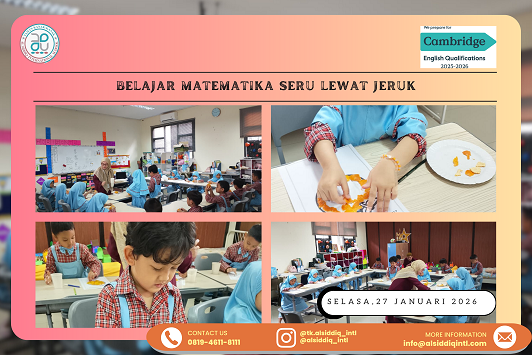
On Monday, 26 January, TK B2 Fatimah Azzahra, and on Tuesday, 27 January 2026, TK B1 Ummu Kultsum of Al Siddiq International carried out a unique and enjoyable mathematics learning activity in the Science and Math classroom. The activity focused on exploring numbers and patterns through hands-on experiences such as peeling oranges, counting the segments of the fruit, and creating mosaics from orange peels. By using a concrete, experiential approach, this activity became an effective way to introduce basic mathematical concepts to early childhood learners.
The activity began with each child receiving an orange. The children were encouraged to peel the fruit independently, helping to develop their fine motor skills. They were then asked to count the number of segments inside the orange. Through direct counting, the children were introduced to number concepts and practised one-to-one counting while enjoying the learning process in a fun and relaxed atmosphere.
Beyond counting activities, the children were also invited to be creative by using the orange peels they had removed. The peels were arranged into simple mosaic patterns on paper. This creative activity aimed to develop imagination and creativity, as well as introduce children to the concepts of patterns and geometric shapes. By using natural materials such as orange peels, learning became more meaningful and closely connected to everyday life.
The purpose of this activity was to introduce basic mathematical concepts such as numbers, quantity, and patterns to young children in a concrete, contextual, and enjoyable way. In addition, the activity supported sensory development and fine motor skills, while fostering careful observation, concentration, and stimulating logical and systematic thinking. Children learned not only through theory, but also through direct experiences that they could see, touch, and understand.
Overall, the activities of peeling oranges, counting fruit segments, and creating mosaics from orange peels at TK B Al Siddiq International provided more than just an introduction to mathematics. They offered a holistic and enjoyable learning experience. Through an interactive and exploratory approach, children became more enthusiastic and actively involved in the learning process. This activity demonstrates that mathematics can be taught in a fun and meaningful way from an early age.
By Inka Amalia, S. Pd