
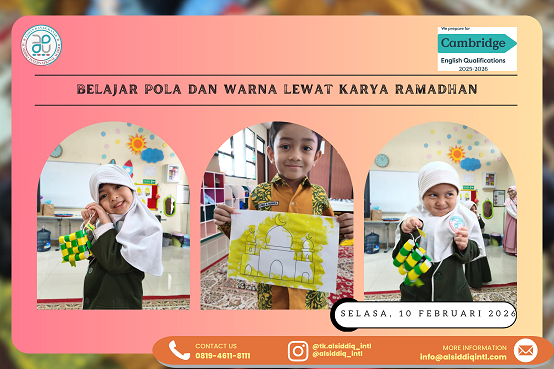
In welcoming the spirit of Ramadan, pupils of Kindergarten A and Kindergarten B at Al Siddiq International took part in two creative activities held in their respective classrooms. On Wednesday, 25 February 2025, the children created mosque-themed stamps. The following day, Thursday, 26 February 2026, they continued with an activity making ketupat decorations. Both activities were designed as part of enjoyable thematic learning suited to the developmental stage of early years children.
In the stamping activity, the teacher first prepared mosque-shaped templates. For Kindergarten A pupils, the mosque patterns had already been cut out by the teacher so that the children could focus directly on the stamping process. Meanwhile, Kindergarten B pupils were given the opportunity to cut out their own mosque patterns under the teacher’s guidance. The teacher then distributed plain sheets of paper as the base. The children applied paint to the template and stamped it repeatedly until the entire surface of the paper was covered in colour. The most eagerly awaited final step was removing the mosque template, revealing a neat and attractive mosque silhouette on their paper.
The following day, the activity continued with making ketupat decorations. For Kindergarten A pupils, the teacher had prepared circular paper cut-outs ready to be arranged. The children arranged them in an A-B-A-B pattern, learning to recognise simple repeating sequences. Once the arrangement was complete, they added a hanging ornament at the bottom and a string at the top as the finishing touch. For Kindergarten B pupils, the teacher prepared half of the circular pieces, while the remaining pieces were made by the children themselves. After all the parts were ready, they arranged them in the same pattern and added a hanging ornament and string so that the decoration could be displayed.
These activities served several important purposes. In addition to introducing symbols associated with Ramadan, such as mosques and ketupat, they also helped develop fine motor skills through cutting, sticking, stamping, and pattern-arranging tasks. The children learned to follow step-by-step instructions, practised concentration, and developed creativity in selecting and combining colours. In particular, during the ketupat arrangement activity, they were introduced to the basic concept of patterns and sequences.
Through these activities, Kindergarten A and Kindergarten B pupils not only produced beautiful creations but also gained meaningful learning experiences. The differing levels of independence between the two classes formed part of the learning process, adjusted to their respective ages and abilities. The classroom atmosphere was lively and full of enthusiasm. With activities such as these, learning becomes more enjoyable while strengthening the children’s understanding of the meaning and traditions of Ramadan.
By Inka Amalia, S. Pd