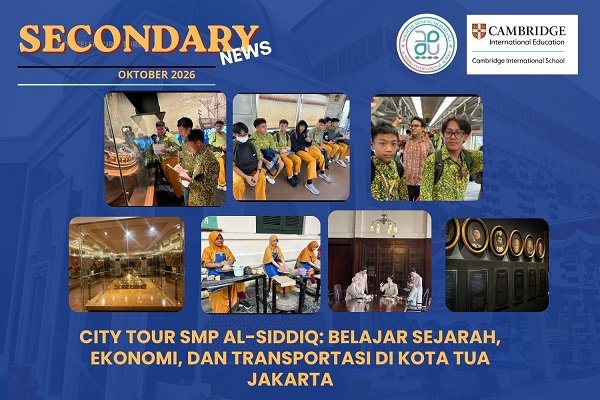
Jakarta, 29 September 2026 — Learning does not always have to take place inside the classroom. This was experienced first-hand by students of SMP Al-Siddiq during an educational City Tour to Jakarta’s historic Old Town (Kota Tua) on Tuesday, 29 September 2026.
Beginning at 8.30 a.m. from Cikunir 1 LRT Station, the activity provided students with a valuable opportunity to learn through direct experience by visiting the Bank Indonesia Museum, Fatahillah Museum (Jakarta History Museum), and an Art Museum.
The trip went beyond learning about history. Students were also introduced to the use of public transport, electronic payment systems, the development of Indonesia’s economy, art and culture, and various historical artefacts that form an important part of the nation’s journey.
Learning About Public Transport from the Very Beginning
The learning experience began from the moment the journey started. The group travelled by LRT and KRL to reach the Kota Tua area.
The use of public transport was deliberately incorporated into the activity so that students would not simply become passengers, but would also gain first-hand experience of how public transport systems operate in an urban environment.
Students were also introduced to the use of e-money as a means of payment. This simple experience provided practical learning about the use of technology in everyday life while also developing independence, discipline, and awareness of proper conduct when using public facilities.
To ensure that the journey remained safe and well organised, the students were divided into 11 groups, with each group accompanied by a homeroom teacher. This system enabled supervision, guidance, care, and communication with students to be carried out more effectively.
Tracing Indonesia’s Economic History at the Bank Indonesia Museum
Upon arriving in Kota Tua, the group visited the Bank Indonesia Museum.
At the museum, students had the opportunity to explore the history of Indonesian currency and the national economy throughout different periods. Various collections illustrated the development of means of payment from the arrival of the Portuguese, Spanish, and Dutch, through to the development of Indonesian currency in the modern era.
Students observed different forms of currency, including banknotes and coins, as well as various objects related to the history of Indonesia’s financial system.
The collection extended beyond currency. Students were also able to see gold bars, securities, sukuk, bonds, and other artefacts illustrating the development of the financial system and the Indonesian economy.
The visit helped students understand that Indonesia’s economic journey cannot be separated from the history of trade and the wealth of natural resources found across the archipelago.
Commodities such as spices, pepper, cinnamon, coffee, and other agricultural products played an important role in the history of Indonesian trade. These natural resources were even among the factors that attracted foreign nations to the archipelago.
By observing the museum collections directly, students were encouraged to understand the connections between natural resources, trade, colonialism, financial systems, and Indonesia’s economic development.
Discovering Jakarta’s History at Fatahillah Museum
After visiting the Bank Indonesia Museum, the journey continued to Fatahillah Museum, also known as the Jakarta History Museum, located not far from the previous destination.
The museum introduced students to Jakarta’s historical journey, from the era of ancient kingdoms through the colonial period.
Students were able to observe various historical collections and replicas, including the Ciaruteun Inscription, Tugu Inscription, and Padrão Sunda Kelapa Inscription, all of which are connected to the history of Jakarta and the wider Indonesian archipelago.
The museum’s thematic rooms also provided an overview of Jakarta’s development, including the Tarumanegara Room, Jayakarta Room, Fatahillah Room, Sultan Agung Room, and Batavia Room.
In addition, students encountered a variety of historical objects, including antique furniture, ceramics, pottery, numismatic collections, weapons, portraits of the Governors-General of Batavia, and a bronze statue of the Roman god Mercury (Hermes).
The antique furniture collection, dating from approximately the 17th to the 19th centuries, also demonstrated the meeting of different cultures, including European, Chinese, and Nusantara influences.
Witnessing the Legacy of Struggle Up Close
One of the sections that particularly captured the students’ attention was the underground prison. The space provided an insight into the conditions experienced by prisoners during the colonial period, who had to endure life in confined and dark surroundings.
Students also had the opportunity to learn about the part of the museum associated with the history of Prince Diponegoro and his imprisonment before his exile.
This experience offered students a different perspective on history. History is not simply about memorising names and dates. It is also a story of people, struggle, hardship, change, and the journey of a nation.
Nurturing an Appreciation for Art and Creativity at the Art Museum
The City Tour continued with a visit to an Art Museum, adding another dimension to the students’ learning experience.
While the Bank Indonesia Museum introduced students to economic history and Fatahillah Museum explored Jakarta’s past, the Art Museum provided an opportunity to discover art, culture, creativity, and the ways in which people express ideas through their work.
At the museum, students were encouraged to observe various artworks closely. They learnt that art is not simply about beauty, but can also serve as a medium for expressing ideas, experiences, cultural identity, history, and perspectives on life.
Seeing artworks directly was also expected to nurture students’ appreciation of art and culture, broaden their horizons, and encourage creativity.
For the students, the visit was an opportunity to learn to see things from different perspectives. An artwork can contain different forms, colours, symbols, and meanings, encouraging students to observe, ask questions, think critically, and express their opinions.
Thus, the visit to the Art Museum became an important part of the educational journey, bringing together history, economics, culture, and creativity in one enriching experience.
The Journey Home: Travelling by KRL and LRT Once Again
After completing the entire series of visits, the City Tour concluded at around 2.00 p.m. The group then began the journey home using public transport once again.
From the Kota Tua area, the students and accompanying teachers travelled by KRL to Cikoko Station. The journey then continued by LRT from Cikoko Station to Cikunir Station, marking the final destination of the trip.
The return journey also provided another opportunity for students to put into practice what they had learnt about using public transport since the morning.
More Than Just a Trip
The SMP Al-Siddiq City Tour demonstrated that education can take place anywhere. This one-day journey brought together various areas of learning, including history, economics, art, culture, technology, transport, discipline, and character education.
Students did not simply observe historical objects; they were encouraged to understand the context behind them. They explored how trade and natural resources influenced Indonesia’s economic journey, how currency developed over time, how Jakarta transformed from the era of kingdoms to the colonial period, and how art can serve as a way for people to preserve ideas and culture.
At the same time, travelling by LRT and KRL provided practical lessons about the importance of orderliness, independence, responsibility, and respect for public facilities.
With 11 homeroom teachers accompanying the respective groups, the activity was also able to take place in a more organised, safe, and conducive manner.
Ultimately, this City Tour was far more than a journey outside school. It became a real-life learning environment, where students could see, observe, ask questions, discuss, and experience first-hand the knowledge they had previously encountered in the classroom.
From Cikunir Station to Kota Tua, from the history of currency to the history of the nation’s struggles, from works of art to modern transport systems, SMP Al-Siddiq students returned home carrying not only memories of their journey, but also new insights into Indonesia’s history, economy, art, culture, and everyday life.
Learning through journeys, discovering history up close, appreciating art, and gaining experiences to help shape a more knowledgeable and globally minded generation.
By Retno Suzanne Handayani, Lc, M.Pd