Al Siddiq International School

Kegiatan

Kegiatan, TK

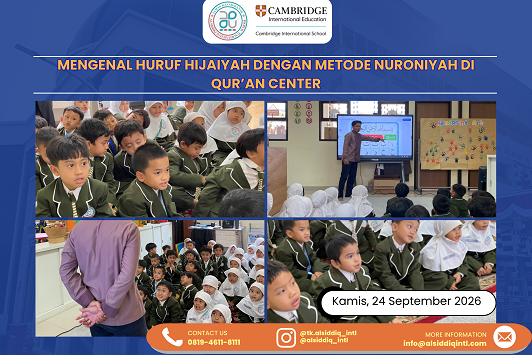
Learning Hijaiyah Letters through the Nuroniyah Method at the Qur’an Centre

On Thursday, 24 September 2026, students of TK Al Siddiq International took part in a Qur’an learning activity at the Qur’an Centre. On this occasion, the children were introduced to the Hijaiyah letters through the Nuroniyah method. This activity formed part of the Qur’an learning programme provided for the children in an enjoyable environment appropriate to their stage of development, particularly within the learning programme at Al Siddiq International. Before beginning the Nuroniyah session, the children followed their usual morning routine. The day began with lining up, followed by journaling. Afterwards, the children performed Duha prayer together. These routines form part of the children’s daily habits, helping them begin their school activities in an orderly manner while introducing Islamic values into their everyday routines. After the Duha prayer, the children were given some time to play before moving on to the next activity. Following playtime, they had snack time, followed by toilet time. Once all the morning routines had been completed, the children prepared to take part in the Nuroniyah learning session together at the Qur’an Centre. The Nuroniyah session was led by Ustadz Mudzakky, the Qur’an teacher at TK Al Siddiq International. During the session, the children were introduced to the Hijaiyah letters as a foundation for learning to read the Qur’an. The Nuroniyah method is one approach to learning Qur’anic reading that is structured progressively, beginning with recognising the Hijaiyah letters and learning how to pronounce them correctly, including paying attention to the makharijul huruf, or the points of articulation of the letters. Learning the Hijaiyah letters through the Nuroniyah method does not focus solely on the children’s ability to recognise the shapes of the letters. They are also guided to understand and pronounce each letter correctly. As learning progresses, the material can gradually move from individual letters to connected letters, followed by an introduction to harakat and other forms of Qur’anic reading. Through these stages, children can develop a stronger foundation before learning to read sequences of Qur’anic verses. Through this activity, the students of TK Al Siddiq International were not only learning to recognise Hijaiyah letters but were also beginning to build a closer relationship with the Qur’an from an early age. Learning took place collectively under the guidance of the teacher, allowing the children to follow examples of pronunciation, listen carefully, and practise saying the letters they were learning. The Qur’an Centre therefore provided a welcoming space where children could learn about the Qur’an in a fun and engaging way. The introduction to Hijaiyah letters through the Nuroniyah method is expected to serve as an important first step in developing the children’s ability to read the Qur’an. Through learning that is carried out gradually and consistently, the children can become increasingly familiar with the Hijaiyah letters, develop accurate pronunciation, and nurture a love for and closer connection with the Qur’an from an early age.By Inka Amalia, S.Pd

Kegiatan, SD

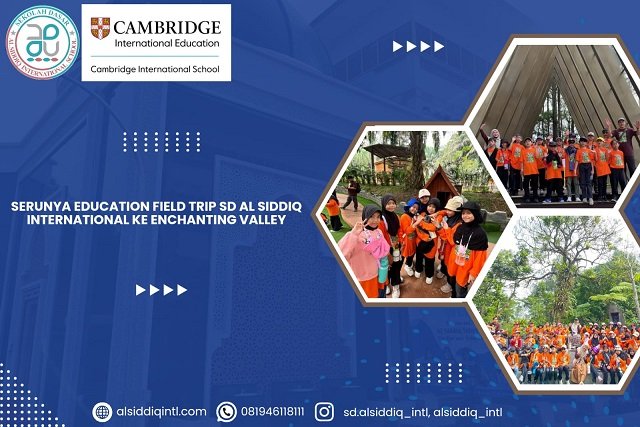
An Exciting Education Field Trip: SD Al Siddiq International Visits Enchanting Valley

On Thursday, 24 September 2026, students of SD Al Siddiq International took part in an Education Field Trip to Enchanting Valley. The activity was part of the school’s approach to learning beyond the classroom, providing students with an educational, enjoyable, and meaningful experience. Through this activity, students had the opportunity to learn through direct observation, exploration, interaction, and a variety of activities with their friends and teachers. From the moment they set off, the students looked enthusiastic and full of excitement. Accompanied by their teachers, they travelled in an orderly manner while learning to maintain togetherness, follow instructions, and take responsibility for themselves and their groups. The cheerful atmosphere throughout the journey marked the beginning of an enjoyable learning experience. Upon arriving at Enchanting Valley, the students took part in various activities that had been prepared for them. The programme began with guidance from the teachers, followed by observation and exploration of the surrounding environment. Students were encouraged to pay attention to interesting things around them, develop their curiosity, and learn through real-life experiences. They also had opportunities to interact with their surroundings and engage in discussions with their friends and teachers. In addition to exploration, the students participated in group activities and educational games designed to develop teamwork, communication, concentration, confidence, and the ability to follow instructions. During each activity, students learnt to support one another, respect their friends, share responsibilities, and overcome challenges together. The outdoor activities also allowed students to stay active while enjoying learning in a more relaxed and enjoyable environment. Moments of togetherness were another important part of the experience. Students had the opportunity to play, rest, eat together, chat, and capture memorable moments with their friends and teachers. Through these shared experiences, students learnt to build positive social relationships, become more independent, and understand the importance of maintaining appropriate behaviour and responsibility when outside the school environment. For SD Al Siddiq International, the Education Field Trip is part of the school’s commitment to providing active, meaningful, and enjoyable learning experiences. Learning does not take place only inside the classroom; valuable lessons can also be gained through direct experiences. Activities such as this provide students with opportunities to develop curiosity, creativity, independence, communication, teamwork, and environmental awareness. Through the Education Field Trip to Enchanting Valley, students gained not only an enjoyable experience but also a range of valuable lessons and positive values to take home. The smiles, laughter, enthusiasm, and sense of togetherness throughout the day created wonderful memories in their educational journey. The Education Field Trip on Thursday, 24 September 2026 was a meaningful example of learning at SD Al Siddiq International that combines education, exploration, togetherness, and character development. Hopefully, this experience will inspire students to remain enthusiastic about learning, continue to be curious, have the courage to try new things, and grow into individuals who are independent, confident, responsible, and able to work well with others. Every place can be a classroom, and every experience can be a lesson. SD Al Siddiq International — Learning Beyond the Classroom, Growing Through Experience.By Muslihatul Maula, Lc

Kegiatan, SMP

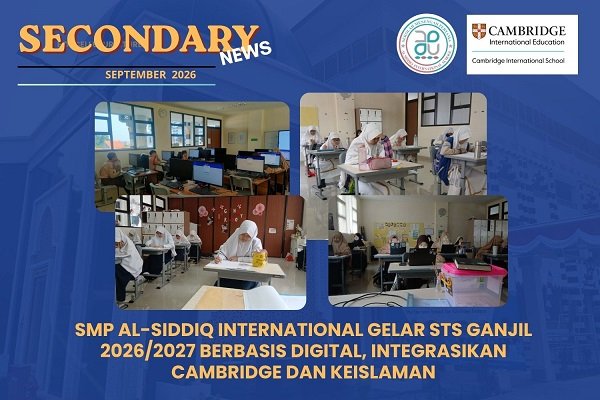
SMP Al-Siddiq International Holds Digital STS for the First Semester of 2026/2027, Integrating Cambridge and Islamic Education

Bekasi, 21 September 2026 — SMP Al-Siddiq International conducted the Mid-Semester Summative Assessment (Sumatif Tengah Semester/STS) for the First Semester of the 2026/2027 Academic Year from 14–21 September 2026. The assessment was attended by all students according to their respective year groups and was conducted using a Learning Management System (LMS), while integrating English in Cambridge-based subjects and Arabic in Islamic education. The STS is an important part of the learning evaluation process, designed to measure students’ competency attainment at the midpoint of the semester. Rather than assessing academic knowledge alone, the assessment programme was also designed to strengthen students’ digital skills, language abilities, and Islamic values. Digital Assessment: Developing Students’ Technological Skills Unlike traditional examinations that rely entirely on printed question papers, this year’s STS at SMP Al-Siddiq International was conducted digitally through the Learning Management System (LMS). Students completed their assessments using the system prepared by the school. This approach forms part of the school’s efforts to familiarise students with the use of technology in academic activities, while encouraging them to become more independent, organised, and responsible throughout the assessment process. The use of technology also supports the educational approach of SMP Al-Siddiq International, which combines the development of knowledge and technological skills with Islamic education. English for Cambridge, Arabic for Islamic Education The integration of a global perspective was also evident throughout the STS. In Cambridge-based subjects, students completed their assessments using English. The use of English helps students become accustomed to learning materials and assessment instructions within an international education context. Meanwhile, Arabic was used in Islamic education subjects as part of the effort to strengthen students’ ability to understand Islamic terminology, learning materials, and Islamic sources. Through this approach, the assessment process serves not only as a means of measuring learning outcomes but also as an opportunity to develop students’ language skills and broaden their knowledge and understanding. STS Goes Beyond Written Assessments One of the distinctive features of the STS at SMP Al-Siddiq International is the inclusion of an oral BBQ (Bimbingan Baca Qur’an) assessment as part of the overall evaluation programme. The oral BBQ assessment focused on the memorisation of selected Qur’anic surahs. This assessment complemented the academic evaluation by incorporating aspects of spiritual development and Islamic character. Through this evaluation, the school seeks to ensure that education is not focused solely on cognitive abilities but also provides opportunities to strengthen students’ relationship with the Qur’an, spirituality, and Islamic character. Measuring Achievement, Building Character Throughout the STS, all students participated in the assessment programme in an orderly and conscientious manner. Teachers and the organising committee also worked to ensure that the entire process was conducted in accordance with the established procedures. Parental support was also an important part of creating a conducive learning environment during the STS. Collaboration between the school and families is expected to help students prepare themselves effectively, both academically and in terms of character development. Overall, the First Semester STS for the 2026/2027 Academic Year was conducted smoothly, orderly, and in a conducive atmosphere. For SMP Al-Siddiq International, the STS is not simply an opportunity to measure students’ academic results. More importantly, it forms part of the school’s educational process in developing a generation capable of integrating knowledge, technology, language skills, the Qur’an, and Islamic character. Through this integration, the school continues to work towards its vision: “To become a globally minded Islamic school that develops a Qur’anic generation with strong knowledge of science and technology, an entrepreneurial spirit, and a commitment to protecting the environment.” The STS programme is expected to serve as a valuable opportunity for students, teachers, and parents to reflect on the progress that has been achieved, while identifying areas for improvement and preparing for the next stage of the learning process.Retno Suzanne handayani, Lc, M.Pd

Kegiatan, TK

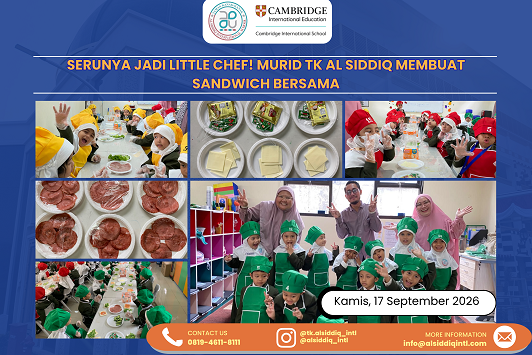
What Fun Being a Little Chef! TK Al Siddiq Students Make Sandwiches Together

On Thursday, 17 September 2026, students of TK Al Siddiq International took part in a cooking class held in the dining room. This time, the children were invited to make simple sandwiches together. The activity provided an enjoyable learning experience as the children were able to participate directly in preparing the food, follow each step of the process, and see the finished dish they had made themselves. Before the activity began, the teacher prepared all the necessary equipment and ingredients for making the sandwiches. The children were also encouraged to pay attention to cleanliness and safety throughout the activity. The teacher helped each child put on an apron and gloves before they went to the dining room. This preparation was an important part of introducing children to the importance of maintaining cleanliness when preparing food. Once everything was ready, the children went together to the dining room and took their seats. The teacher then introduced the ingredients that would be used and explained the steps for making the sandwiches one by one. The teacher demonstrated the process from the initial preparation until the sandwich was ready to be enjoyed, while the children carefully observed each step. The children then had the opportunity to make their own sandwiches by following the teacher’s example. They completed each step gradually and carefully arranged the ingredients provided. The activity allowed the children to develop hand-eye coordination, follow instructions, and complete a task in sequence. They also learnt that preparing food requires attention to detail and patience. The cooking class was not only an opportunity to introduce children to food preparation but also a way to develop a variety of important skills. While cooking, children learnt to follow instructions, recognise different food ingredients, develop independence, and strengthen their fine motor skills through handling and arranging the ingredients. Cooking together also encouraged them to wait for their turn, work cooperatively, and take responsibility for the activity they were involved in. Once the sandwiches had been completed, the teacher helped the children wrap their creations. The children were then able to see the results of the process they had completed from beginning to end. This experience gave them a sense of achievement as they had successfully made a simple food item by following the steps demonstrated by their teacher. Through this sandwich-making activity, the students of TK Al Siddiq International learnt not only about the process of preparing food but also gained a learning experience that supported various areas of their development. The cooking class provided an opportunity for children to learn through first-hand experience, try something new, and enjoy creating something together with their friends. In a fun and engaging atmosphere, the children learnt that everyday activities such as preparing food can also become meaningful learning experiences. Little hands, big creativity, and lots of fun!By Inka Amalia, S.Pd

Kegiatan, SD

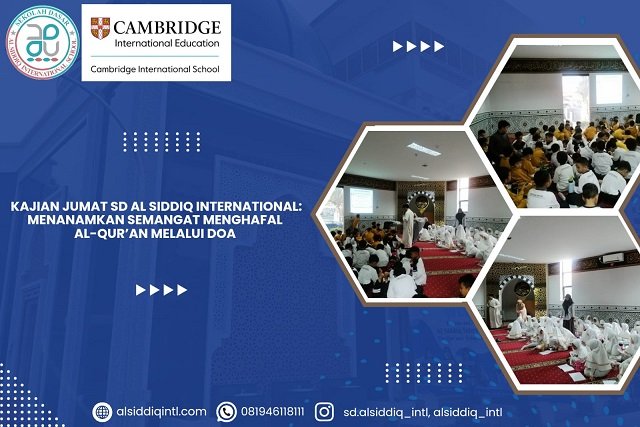
Friday Islamic Study Session at SD Al Siddiq International: Nurturing the Spirit of Qur’an Memorisation Through Prayer

Bekasi, 18 September 2026 — SD Al Siddiq International once again held its Friday Islamic Study Session (Kajian Jumat) as part of its Islamic education and character-building programme. Held during the Halaqah session, the activity took place in the school mosque and was attended by students in an orderly, respectful, and enthusiastic manner. The Friday Islamic Study Session is one of the school’s regular programmes, providing students with continuous opportunities to learn about Islam. Through this activity, students not only gain an understanding of Islamic teachings but are also encouraged to develop positive habits and apply Islamic values in their daily lives. The theme of this Friday’s session was “A Prayer to Make Qur’an Memorisation Easier.” The topic was closely connected to Qur’an learning, which is an important part of education at SD Al Siddiq International. Students were encouraged to understand that the process of memorisation, particularly the memorisation of the Qur’an, requires dedication, discipline, patience, and consistency. During the session, students were introduced to a prayer that can be recited to seek ease in learning and memorisation. The prayer was then recited together by the students. Through this activity, students were encouraged to recognise that every learning process should begin by seeking help and ease from Allah SWT. In addition to learning the prayer, students were also given an understanding of the importance of making sincere efforts in the memorisation process. Prayer should be accompanied by earnest effort, such as regularly reading and revising memorised passages, maintaining concentration, paying attention to recitation, and developing discipline in learning. In this way, students are encouraged to understand that memorisation is a gradual process that requires consistency and perseverance. Holding the activity in the mosque also formed part of the students’ learning about proper manners and etiquette. The children were encouraged to maintain order, quietness, and cleanliness, as well as to respect the mosque as a place of worship and learning. These habits are expected to nurture discipline, responsibility, and care for others, which can be applied not only at school but also in everyday life. The Friday Islamic Study Session during the Halaqah period gave students an opportunity to learn in an environment different from their usual classroom setting. By gathering together in the mosque, students experienced a form of learning that combined knowledge, spirituality, and character development. This reflects SD Al Siddiq International’s commitment to providing an education that is not solely focused on academic achievement but also on developing individuals who are faithful, well-mannered, and deeply connected to the Qur’an. May Allah SWT continue to grant ease, guidance, and blessings in every pursuit of knowledge and make the Qur’an a source of guidance in the lives of all students. May the students of SD Al Siddiq International grow into a Qur’anic generation who are knowledgeable, possess noble character, love the Qur’an, and remain close to Allah SWT. Ameen, ya Rabbal ‘alamin.By Muslihatul Maula, Lc

Kegiatan, SMP

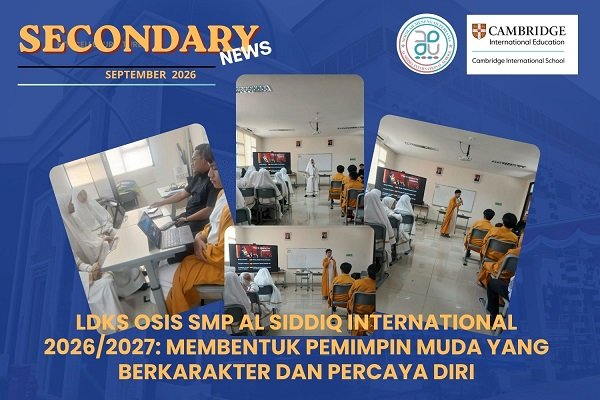
LDKS OSIS SMP Al Siddiq International 2026/2027: Developing Confident Young Leaders with Strong Character

Bekasi, 18 September 2026 — SMP Al Siddiq International held the Student Leadership Basic Training (Latihan Dasar Kepemimpinan Siswa/LDKS) for the OSIS Student Council for the 2026/2027 Academic Year on Friday, 18 September 2026. The activity took place in the Year 8 and Year 9 Boys classrooms and was attended by students of SMP Al Siddiq International. LDKS is an important programme designed to prepare prospective OSIS committee members with essential leadership skills, communication abilities, organisational skills, and the confidence to take on roles and responsibilities in running the student organisation. Dhikr and Prayer to Begin the Programme The programme began with dhikr and a collective prayer as an expression of hope and effort that the entire LDKS programme would run smoothly and provide meaningful benefits for all participants. The opening session was then followed by a Qur’anic recitation (tilawah Al-Qur’an) delivered by Muhammad Kautsar. The atmosphere became even more solemn as all SMP Al Siddiq International students joined together in singing the Indonesian national anthem, “Indonesia Raya”. Opening Remarks: Leadership Begins with Oneself The programme continued with opening remarks from Mrs Robiah Adawiyah, M.Pd. In her remarks, she emphasised that leadership is not simply about the ability to lead others, but first and foremost about the ability to lead oneself. A leader needs to demonstrate responsibility, discipline, courage in making decisions, teamwork, and positive role modelling through their attitudes and actions. Therefore, LDKS is intended to provide students with an opportunity to learn how to take responsibility for their duties, respect others, and have the confidence to take an active role within the school environment. Public Speaking Session: Building Confidence and Overcoming Stage Fright The first session focused on Public Speaking, delivered by Mr Arief Reza, S.S. The session lasted approximately two and a half hours and involved more than simply presenting theoretical material. Students were given the opportunity to practise their public speaking skills directly in front of the class. One by one, participants came to the front of the classroom to practise public speaking. After each performance, participants received feedback, evaluation, and suggestions for improvement. This enabled them to identify areas that could be developed, including confidence, articulation, intonation, body language, eye contact, and the way they presented their ideas. Interestingly, the session brought out a variety of experiences among the participants. Some students experienced stage fright and nervousness when they first stood in front of their classmates. Nevertheless, they made an effort to overcome their nervousness and continued trying. Others performed with confidence, while several participants already demonstrated fairly strong public speaking abilities. These different experiences became an important part of the learning process. Students learnt that effective public speaking requires not only knowledge but also the courage to try, openness to feedback, and a willingness to continue improving. Through this practical session, participants were expected to develop stronger public speaking skills and become more confident when expressing ideas, leading meetings, giving presentations, or speaking in front of larger audiences. Character-Based Leadership The programme continued with a session on Character-Based Leadership. During this session, participants were encouraged to understand that a leader needs more than technical leadership skills. Leaders must also possess strong character, including integrity, responsibility, discipline, honesty, care for others, teamwork, and the ability to serve as positive role models. These qualities form an important foundation for OSIS committee members, enabling them to carry out their organisational responsibilities effectively while becoming positive examples for other students. Organisation Management and Work Programmes At 12.00 p.m. WIB, the programme entered the break for prayer and lunch (ISHOMA). Following the break, all participants resumed the LDKS programme at 1.00 p.m. WIB with a session on Organisation Management and Work Programmes. The third session was delivered by Amal Dzikrullah, M.Pd. During this session, participants learnt how an organisation can operate effectively through the distribution of responsibilities, coordination, communication, programme planning, and cooperation among committee members. Participants were also encouraged to understand that a work programme should not simply be based on an interesting idea. It needs to be developed systematically and realistically, with clear objectives, defined responsibilities, an implementation schedule, and an evaluation process. This training is expected to help prospective OSIS committee members develop and implement work programmes that are creative, well organised, purposeful, and beneficial to the entire school community. Organisational Meeting Procedures The fourth session focused on Organisational Meeting Procedures, delivered by Mrs Retno Suzanne Handayani, Lc., M.Pd. This session provided participants with an understanding of organisational meeting procedures, including how to participate in meetings in an orderly manner, understand discussion mechanisms, express opinions, and uphold the rules and ethics of organisational forums. Understanding meeting procedures is an important skill for OSIS committee members, as students will encounter various forums when discussing programmes, making decisions, and addressing organisational matters. Closing the LDKS Programme After all the training sessions had been completed, the LDKS OSIS SMP Al Siddiq International 2026/2027 programme concluded with a prayer led by Ustadz Ahmad Toha, M.Ag. The entire programme was filled with enthusiasm and meaningful learning experiences. Participants gained not only knowledge about leadership and organisation but also practical experience in public speaking, teamwork, receiving feedback, overcoming nervousness, and having the courage to take on responsibilities. Through this LDKS programme, SMP Al Siddiq International hopes that the prospective OSIS committee members for the 2026/2027 period will be able to carry out their organisational responsibilities effectively and help develop OSIS into an increasingly active, creative, productive, and impactful student organisation. More than simply preparing students to become members of an organisation, LDKS is expected to serve as an important first step in developing a generation of young people with leadership skills, strong character, effective communication abilities, confidence in public speaking, teamwork, and a strong sense of responsibility. With these skills and values, students are expected to grow into individuals who are not only capable of leading an organisation but are also able to lead themselves, confidently express their ideas, and make positive contributions to their school and wider community.By Retno Suzanne
Kegiatan, TK

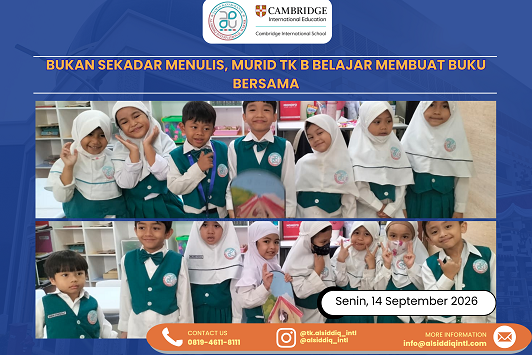
More Than Just Writing: TK B Students Learn to Make a Book Together

On Monday, 14 September 2026, TK B students of Al Siddiq International took part in a learning activity at the Preparation Centre (Sentra Persiapan), where they created a simple storybook together. The activity was designed as a way to observe and assess how well the children could remember letters and write them. Through this group-based activity, the children not only practised writing but also learnt to communicate, work together, and become more familiar with their school environment. Before beginning the activity, the teacher invited the children to discuss the people who are part of the kindergarten community and the wider school community. The children were encouraged to recall the various people they meet in their daily school activities, such as teachers and other members of the school community. This discussion helped the children understand that everyone in the school community has their own important role. After the discussion, the teacher showed the children an example of a simple storybook that had been prepared beforehand. The teacher demonstrated how several sheets of writing could be arranged and put together to create a simple book. The example gave the children a clear idea of the activity they would be doing and the final product they would create together. The TK B students were then divided into two groups. Each child had the opportunity to help write the name of a teacher or another member of the school community. Rather than simply being given the names to copy, the children were encouraged to ask directly about each letter in the name they wanted to write. In this way, they were encouraged to remember the shape and sequence of the letters and attempt to write them independently. The activity also provided a learning experience involving direct interaction between the children and teachers or other members of the school community. When asking about the letters in a name, the children learnt to listen, remember information, and connect it with the writing skills they had already learnt. This process made writing feel more relevant to their everyday experiences at school. Once all the children had completed their sections, the group leaders helped coordinate their friends’ work. Each sheet was collected and arranged together to form a simple storybook. The children were able to see how their individual contributions could be combined to create a shared piece of work. Through this simple storybook-making activity, the TK B students of Al Siddiq International had the opportunity to develop their ability to recognise and write letters in an enjoyable learning environment. In addition to observing the children’s ability to remember letters, the activity also encouraged teamwork, communication, responsibility, and the ability to follow a process from beginning to end in creating a shared piece of work. In this way, learning at the Preparation Centre is not focused solely on academic skills but also provides meaningful experiences that support the children’s overall development.By Inka Amalia, S.Pd

Kegiatan, SD

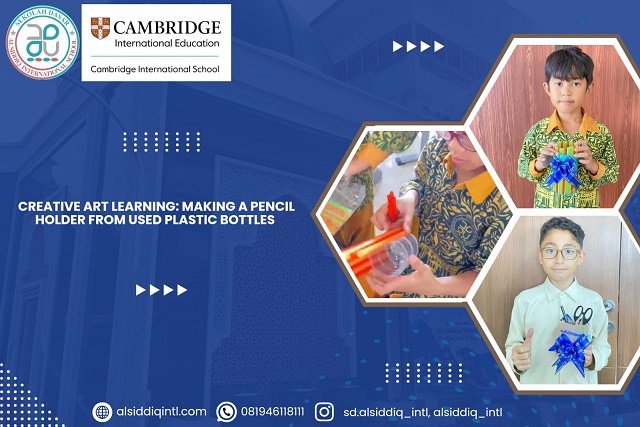
Creative Art Learning : Making a Pencil Holder from Used Plastic Bottles

On Wednesday and Thursday, 16 and 17 September 2026, Year 4A and Year 4B students of SD Al Siddiq International took part in an Art learning activity entitled “How to Make a Pencil Holder from a Used Plastic Bottle.” The activity provided the students with an opportunity to learn creatively while producing a useful piece of artwork. During the activity, the students were encouraged to reuse used plastic bottles and transform them into pencil holders. With guidance from their teacher, the students were first introduced to the materials and the steps involved in making the pencil holders. After receiving the instructions, they began creating their own pencil holders by following the steps while also developing their individual creativity. The learning atmosphere in Year 4A and Year 4B was cheerful and filled with enthusiasm. The students looked excited and happy as they worked on their creations. They enjoyed every stage of the process, from preparing the materials and transforming the plastic bottles to decorating and completing their pencil holders according to their own ideas and imagination. This activity not only developed the students’ artistic skills and creativity but also encouraged attention to detail, independence, patience, and fine motor skills. Each student had the opportunity to express their own ideas, resulting in creations that were different and unique. This made the learning process more engaging and provided the students with an enjoyable learning experience. Furthermore, reusing used plastic bottles in the Art activity also taught students about the importance of protecting the environment and giving reusable materials a second life. The students learnt that used items do not always have to be thrown away; instead, they can be transformed into useful objects through creativity. Through activities like this, SD Al Siddiq International continues to provide active, creative, and meaningful learning experiences. Students do not learn solely through theory but also gain first-hand experience through practical activities. In this way, learning can help develop their creativity while also fostering greater awareness and care for the environment around them. The enthusiasm and happiness shown by the Year 4A and Year 4B students were valuable parts of this learning experience. Hopefully, through Art activities like this, students will become increasingly confident in expressing their creativity, willing to try new things, and able to recognise opportunities to create useful objects from simple materials around them. Keep creating, keep learning, and keep caring for our environment!By Muslihatul Maula, Lc

Kegiatan, SMP, Uncategorized

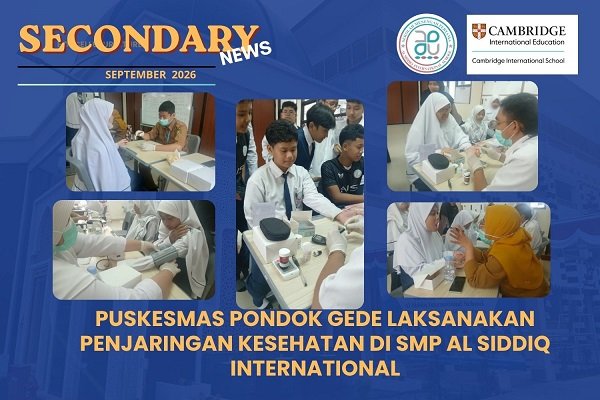
Pondok Gede Community Health Centre Conducts Student Health Screening at SMP Al Siddiq International

Bekasi, 14 September 2026 – SMP Al Siddiq International welcomed a team from the Pondok Gede Community Health Centre (Puskesmas Pondok Gede) to conduct a student health screening as part of the School Health Programme (UKS). The activity was part of a joint effort to monitor students’ health and physical development, as well as to detect health issues at an early stage that could affect their comfort and learning process at school. The visiting team from Puskesmas Pondok Gede was warmly welcomed by the Head of SMP Al Siddiq International, Mrs Robiah Adawiyah, M.Pd. The school welcomed the activity as an example of positive collaboration between educational institutions and health services in supporting students’ health and well-being. The screening was conducted gradually and in rotation in the Year 9 Boys classroom. The examination began with the male students and was then followed by the female students. This arrangement was intended to ensure that the entire screening process could take place in an orderly, comfortable, and conducive environment. Monitoring Students’ Growth and Nutritional Status As part of the health screening, Puskesmas staff conducted physical examinations and monitored students’ nutritional status by measuring their weight and height. These measurements formed part of the monitoring of students’ physical growth. The health team also checked personal hygiene, including the condition of students’ hair, nails, skin, and ears. In addition, eye and ear examinations were carried out. The eye examination included a visual acuity test to identify potential vision problems that could affect students’ ability to participate in learning. The ear examination assessed the condition of the ears and checked for possible hearing difficulties. Dental and Oral Health Examination Dental and oral health were also included in the screening process. Health officers examined students’ teeth and gums, including checking for possible dental caries, tartar, and gum problems. If any condition requiring further attention was identified, students could receive recommendations or referrals to obtain appropriate healthcare services at the Puskesmas. School Environmental Health Inspection The health team from Puskesmas Pondok Gede also paid attention to the health and safety of the school environment. Following the occurrence of volcanic ashfall, the Environmental Health/Sanitation Officer from the Puskesmas inspected the school environment and water facilities. The inspection was carried out to ensure that the school environment remained safe and supportive of the health of the entire school community. The officer checked the physical condition of the water from the school taps and water sources, including any possible changes in colour, sediment, or odour. The condition of the water tank and water storage facilities was also inspected, including ensuring that the storage containers were properly covered. If any indication of contamination was identified, the school would receive appropriate follow-up guidance from the Puskesmas based on the findings from the inspection. Education on Handling Volcanic Ash The environmental inspection also included guidance on dealing with volcanic ash that had accumulated around the school premises. The health officers provided advice on appropriate cleaning methods to prevent the ash from becoming airborne and being inhaled. The ash should be dampened with water before cleaning so that the particles do not easily become airborne. The inspection also considered the condition of classrooms, windows, doors, and ventilation systems to ensure that there was no accumulation of ash that could affect indoor air quality. In rooms equipped with air conditioning, attention was also given to the cleanliness of the air filters. Immunisation Services for Female Students The programme was then followed by immunisation services for female students, according to the screening results, immunisation status, age, and the requirements of the Puskesmas programme. This immunisation service formed part of the school’s efforts to protect students’ health, including HPV vaccination for eligible female students in accordance with the applicable immunisation programme requirements. Strengthening Collaboration Between the School and Puskesmas The student health screening at SMP Al Siddiq International demonstrated the positive collaboration between the school and Puskesmas Pondok Gede in promoting a healthy lifestyle within the educational environment. Through this activity, the school demonstrated its commitment not only to students’ academic development but also to their physical health, personal hygiene, dental and oral health, sensory health, nutritional status, and the health of the school environment. SMP Al Siddiq International extends its appreciation to Puskesmas Pondok Gede for conducting the student health screening and providing environmental health education. It is hoped that this collaboration will continue to grow, creating a healthy, safe, comfortable, and supportive school environment that enables students to learn and develop to their full potential.By Reto Suzanne handayani, Lc, M.Pd

Kegiatan, SMP

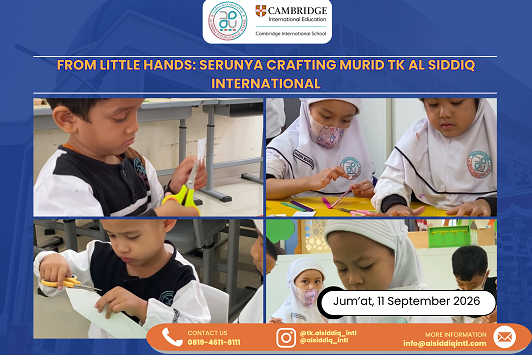
From Little Hands: The Joy of Crafting at Al Siddiq International Kindergarten

On Friday, 11 September 2026, students from Kindergarten A and Kindergarten B at Al Siddiq International took part in a Crafting activity held in the Dining Room. The activity formed part of the school’s art learning programme, giving students an opportunity to explore their creativity through hands-on artistic activities. In a fun and interactive learning atmosphere, the children were encouraged to express their ideas while developing a range of skills that support their overall growth and development. Crafting is not only about producing an artwork. It also provides important benefits for children’s fine motor development. While making crafts, students use their hands and fingers in a variety of ways, including holding, cutting, sticking, positioning, and completing small details of their creations. These activities help develop hand-eye coordination and strengthen the small muscles in the hands and fingers, which are important for children’s readiness to engage in writing activities. A Structured Morning Routine Before beginning the main activity, the students took part in a structured morning routine. The day began from 08.00–08.10 with lining up, followed by Journaling from 08.10–08.30. Through journaling, students had the opportunity to express their experiences, ideas, or feelings through drawings and early writing, according to their individual stages of development. The activity continued with Qur’an learning and Murojaah from 08.30–09.00, as part of the students’ daily routine and the reinforcement of their Islamic learning. From 09.00–09.30, the students performed the Duha Prayer. This was followed by Snack Time and Toilet Time from 09.30–10.00. This series of activities helped the children develop positive habits, from following routines in an orderly manner and maintaining personal hygiene to learning how to meet their own needs independently. Creating a Pencil-Shaped Keychain The main activity took place from 10.00–10.30, when the students made a pencil-shaped keychain. The children followed the teacher’s instructions and created their crafts using their own hands. Throughout the process, they were encouraged to work carefully, follow simple steps, and use hand-eye coordination when arranging and completing their creations. At the same time, each child was given the freedom to enjoy the creative process and express their creativity in their own way. Creating a pencil-shaped keychain provided the students with an enjoyable yet meaningful learning experience. The pencil-inspired design was also closely connected to their everyday learning activities. Through this activity, the children learnt not only about art and creativity but also developed hand skills that will support their academic activities, particularly as they continue developing their early writing abilities. Learning Through Creativity Once the Crafting activity was completed, the learning programme concluded at 10.30, before the students prepared to go home. Through activities such as this, Al Siddiq International continues to provide a holistic learning experience by combining academic learning, Islamic routines, creativity, and motor skill development. The Crafting activity also taught the Kindergarten A and Kindergarten B students that creating something is not simply about the final result. It is also about the process of trying, exploring, creating, and completing something through their own efforts. A simple activity such as making a pencil-shaped keychain can therefore become a meaningful part of children’s development, while also nurturing their confidence and love of learning. Little hands, big creativity, meaningful learning!By Inka Amalia, S.Pd

Kegiatan, SD

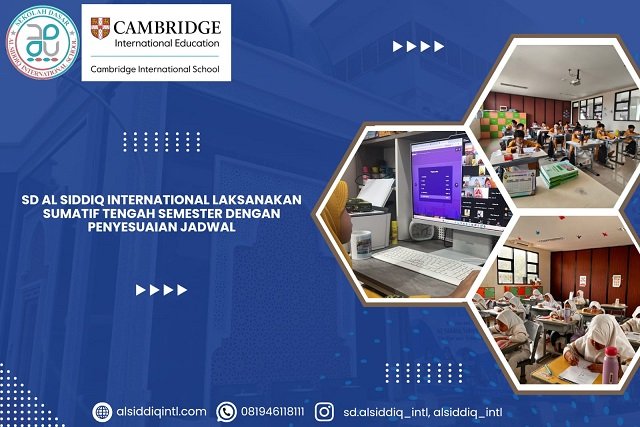
Al Siddiq International Primary School Conducts Mid-Semester Summative Assessment with an Adjusted Schedule

Alhamdulillah, Al Siddiq International Primary School has successfully conducted its Mid-Semester Summative Assessment (Sumatif Tengah Semester or STS) as part of the students’ learning evaluation programme for this semester. The STS is an important opportunity for students to assess their understanding of the various subjects and learning materials they have studied throughout the learning process in the classroom. The STS began on Monday, 7 September 2026. From the first day, students took part in the assessment in an orderly manner and with great dedication. Each student made every effort to demonstrate their best abilities when completing the questions prepared in accordance with the learning materials covered. During the STS period, the assessment schedule was adjusted due to environmental conditions involving volcanic ash. To safeguard the health, safety, and comfort of all students and members of the school community, learning activities on Tuesday, 8 September and Wednesday, 9 September 2026 were conducted through Distance Learning (PJJ). Although learning activities were conducted from home, the students’ enthusiasm for learning remained strong. Students participated in PJJ sessions with their teachers through the learning system prepared by the school. Teachers continued to provide guidance and support, ensuring that the learning process could run effectively while students were studying from home. The adjustment also affected the STS schedule. The STS subjects originally scheduled for Tuesday, 8 September and Wednesday, 9 September were rescheduled to Monday and Tuesday, 14–15 September 2026. This ensured that students continued to have the opportunity to complete the entire STS programme according to the revised schedule. Following the PJJ sessions on 8–9 September, the STS resumed on site at school on Thursday, 10 September and Friday, 11 September 2026. Students returned to school and continued their assessments with enthusiasm. The STS sessions were conducted in an orderly, calm, and conducive atmosphere, allowing students to concentrate fully on completing each assessment. The STS is not only a means of measuring students’ academic achievement but also contributes to their character development. Through the assessment process, students are encouraged to practise honesty, discipline, independence, responsibility, self-confidence, and effective time management. For teachers, the STS results will provide valuable information for evaluating each student’s learning progress. The results can also serve as one of the foundations for determining appropriate follow-up learning activities, enabling the educational process to continue to respond to the needs and development of each student. Meanwhile, the schedule adjustment due to the volcanic ash situation has provided an important learning experience for the entire school community about the importance of prioritising collective health and safety. Through PJJ, the educational process can continue without disregarding environmental conditions or students’ safety. Al Siddiq International Primary School remains committed to providing a safe, comfortable, meaningful, and high-quality learning experience for all students. Whether through face-to-face or Distance Learning, the school continues to strive to ensure that the educational process runs effectively and optimally. May all students of Al Siddiq International Primary School be granted ease, success, good health, and the best possible results throughout the entire Mid-Semester Summative Assessment. May every effort, prayer, and hard work become part of their journey towards achieving even greater success in the future. Keep learning, keep growing, and always do your best! Barakallahu fiikum, students of Al Siddiq International Primary School. Keep up the spirit throughout the STS and stay healthy!By Muslihatul Maula, Lc

Kegiatan, SMP

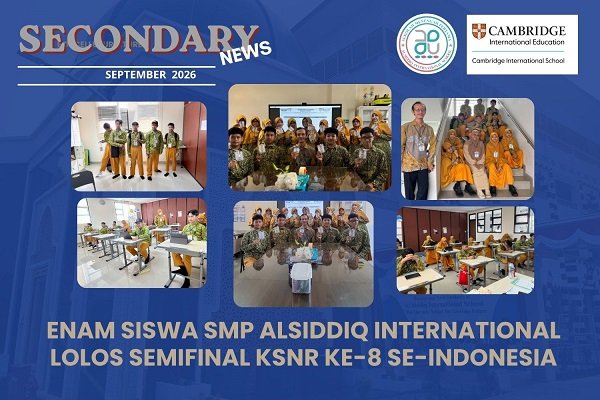
Six Al Siddiq International Secondary School Students Reach the 8th National KSNR Semifinals

Alhamdulillah, Al Siddiq International Secondary School has once again achieved an outstanding accomplishment through the success of six students in the 8th Kompetisi Sains Nalaria Realistik (KSNR), a national-level competition. All six students have qualified for the national KSNR 8 semifinals, demonstrating their reasoning abilities, dedication to learning, and enthusiasm for competing at national level. The 8th KSNR competition was held online on Saturday, 12 September 2026, allowing participants to take part from their respective schools. At Al Siddiq International Secondary School, the competition was conducted on the school premises with teacher supervision and support. The six Al Siddiq International Secondary School students who successfully qualified for the semifinals are: Cordelia Elodie – Grade 8Muhammad Alvaro Siregar – Grade 8Muhammad Kautsar – Grade 9Khalisa Adinta Rukmiputri – Grade 9Raisafa Saffir Audyra – Grade 9Alanza Lareina Clarissa – Grade 9 Throughout the competition, the students received dedicated and intensive guidance from Mr Muhammad Fathul Ihsan, M.Res., Science teacher at Al Siddiq International Secondary School. KSNR is a competition designed to develop students’ ability to reason, analyse, think critically, and solve problems logically and realistically. Participation in this national-level competition is one of Al Siddiq International Secondary School’s efforts to provide students with opportunities to develop their academic potential while also building the confidence and courage to compete at a wider level. The success of these six students is certainly a source of pride for the school. This achievement is also the result of the students’ dedication and determination, the guidance provided by their teacher, and the support of their parents. The entire Al Siddiq International Secondary School community extends its warmest congratulations and highest appreciation to Cordelia, Alvaro, Kautsar, Khalisa, Raisafa, and Reina for their achievement. May Allah SWT grant them ease, confidence, tranquillity, and the best possible results in the upcoming semifinal round. May this achievement inspire all students of Al Siddiq International Secondary School to continue learning, pursuing excellence, and developing their abilities in a wide range of fields. Best of luck in the KSNR 8 semifinals! Keep reasoning, keep learning, and keep achieving!By Retno Suzanne Handayani, Lc, M.Pd