
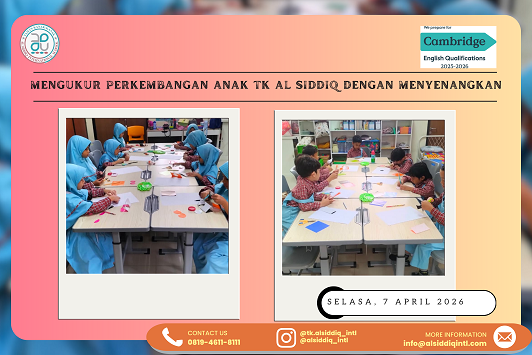
The Mid-Semester Assessment is a periodic evaluation activity conducted to observe children’s learning development. This activity plays an important role in the educational process, particularly at the kindergarten level, as it helps teachers understand how far children’s abilities have progressed after participating in learning over a period of time.
This Mid-Semester Assessment was attended by all pupils of Al Siddiq International Kindergarten. Each child participated according to their individual abilities and developmental stage. Teachers acted as facilitators, providing guidance while creating a comfortable atmosphere so that children felt happy throughout the assessment process.
The assessment was carried out in the classroom, allowing children to remain in a familiar and secure environment. A well-known classroom setting helped the children feel more confident in taking part in each assessment activity. In addition, the classroom arrangement was adapted to support the various activities conducted during the assessment.
The Mid-Semester Assessment was conducted over five days, from Monday to Friday, 6th to 10th April 2026. Each day, children took part in scheduled assessment activities, ensuring that all areas of learning were covered in a balanced way without causing the children to feel overwhelmed.
The purpose of this quarterly assessment is to monitor students’ development across six key areas: religious and moral values, social-emotional development, language, cognitive skills, physical-motor development, and the arts. Through this assessment, teachers are able to identify each child’s strengths and needs, enabling them to provide appropriate stimulation to support optimal growth and development.
The assessment was implemented using a variety of enjoyable methods aligned with children’s world of learning. Each day, the children engaged in different subjects such as literacy, science, mathematics, art, physical education, ICT, the Qur’an, and Arabic. The forms of assessment also varied, ranging from answering simple questions and completing worksheets to producing creative work such as drawings or small projects. In this way, children continued to feel as though they were playing while learning, ensuring that the assessment process remained smooth, meaningful, and enjoyable.
By Inka Amalia, S. Pd