Al Siddiq International School

TK

Kegiatan, TK

Colourful Lanterns and Mosaics for Ramadan

In welcoming the holy month of Ramadan, pupils from Kindergarten A and Kindergarten B at Al Siddiq International took part in a creative activity making lanterns and mosaic hangings shaped like the moon and stars. The activity became both an enjoyable and meaningful moment for the children. With classrooms filled with enthusiasm, they learned while creating, using their own hands and imagination. The lantern-making activity was held on Monday, 23 February 2025, in their respective classrooms. The teachers first printed out the prepared lantern templates. The children then decorated them by colouring according to their creativity. For Kindergarten A, the words “Ramadan Mubarak” were already printed on the template, allowing them to focus on colouring and enhancing the design. Meanwhile, the Kindergarten B pupils wrote “Ramadan Mubarak” themselves using crayons before decorating their lanterns. During the process, Kindergarten A pupils were still assisted by teachers when cutting out the templates and gluing the pieces together. In contrast, Kindergarten B pupils completed the task more independently, with teachers only guiding them through the steps. The following day, Tuesday, 24 February 2026, the activity continued with the creation of moon and star mosaic hangings. Teachers prepared origami paper as the main material and printed out moon and star patterns. The children then filled the patterns by sticking on small pieces of colourful paper. Once the entire surface was neatly covered, the finished work was cut out following its shape and fitted with a string so that it could be hung as a decoration. This activity aimed to introduce the meaning and atmosphere of Ramadan to the children from an early age in a fun and age-appropriate way. In addition, it helped to develop fine motor skills through colouring, cutting, sticking, and writing activities. The children learned to follow instructions, to be patient in completing their tasks, and to build confidence when seeing their finished creations. The differing levels of independence between Kindergarten A and Kindergarten B also formed part of the learning process, adjusted to each stage of development. Through the lantern and mosaic-making activities, the pupils of Kindergarten A and Kindergarten B not only produced beautiful Ramadan decorations but also gained valuable learning experiences. They learned to work neatly, to take responsibility for their tasks, and to appreciate both their own work and that of their friends. The classroom atmosphere felt warm and joyful, reflecting the spirit of welcoming Ramadan with happy hearts.By Inka Amalia, S.Pd

Kegiatan, TK

Welcoming Ramadan with Creativity: Online Activities of Al Siddiq International Kindergarten Pupils

On Wednesday and Thursday, 18 and 19 February 2026, pupils of Al Siddiq International Kindergarten carried out online learning through the school’s Learning Management System (LMS). The activities were completed from home by working on and submitting assignments in the form of videos via the LMS platform provided by the school. Although it was the holiday period leading up to the fasting month, the learning process continued in a more flexible and creative manner. Previously, on Monday, 16 February 2026, the class teacher had informed parents about the online learning plan. The announcement explained in detail the tasks the children were required to complete, along with clear instructions and submission deadlines. Parents were asked to accompany their children during the task preparation process and to assist with recording and uploading the videos to the LMS. On Wednesday, the children were assigned to create a video message welcoming the month of Ramadan. Through this activity, they learnt to deliver simple sentences confidently while understanding the significance of the arrival of the holy month. Each child recorded their greeting video in their own unique style and expression. Some appeared shy with sweet smiles, while others enthusiastically conveyed their prayers and hopes for Ramadan. On Thursday, the task continued with the creation of a Ramadan card. The children were encouraged to be creative by designing a Ramadan-themed card using materials available at home. The entire process was recorded on video, starting from preparing the tools and materials, decorating the card, to presenting the final result. After completing their craft, the children also made a simple presentation video to explain their work. This activity helped develop creativity, fine motor skills, and confidence in speaking in front of the camera. The use of the LMS with a video submission system served several important purposes. Firstly, it ensured that learning activities remained structured despite the pre-Ramadan holiday. Secondly, it nurtured independence and responsibility in completing tasks. Thirdly, it strengthened collaboration between the school and parents in supporting learning at home. Furthermore, the use of the LMS helped both children and parents become more accustomed to using technology in a positive and purposeful way. Through these activities, the atmosphere of welcoming Ramadan became more meaningful. The children were not merely on holiday; they continued to learn, create, and understand religious values in an enjoyable way. Online learning through the LMS proved to be an effective alternative for maintaining enthusiasm for learning while preparing to welcome the holy month with joyful hearts.By Inka Amalia, S. Pd

Kegiatan, TK, Uncategorized

Meaningful Learning from Home: Online Classes at Al Siddiq International Kindergarten

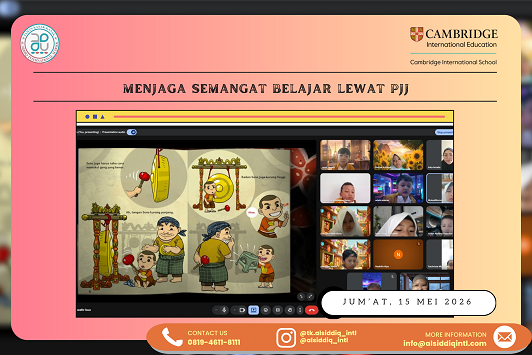
On Friday, 20 February 2026, pupils of Al Siddiq International Kindergarten took part in online learning via Google Meet. The activity was held as the day formed part of the holiday period leading up to the fasting month. Although they were not physically present at school, the children were still able to meet their class teachers and friends through the screen. The learning atmosphere remained warm and enjoyable, even though it was conducted from their respective homes. This distance learning programme aimed to ensure that the learning process continued uninterrupted, despite the approaching holiday before Ramadan. In addition, the activity served as a way to maintain the children’s enthusiasm for learning. By staying connected online, the children were able to maintain positive habits such as reciting prayers before lessons and performing murojaah (revision of Qur’anic memorisation). The online sessions also helped parents stay informed about the school’s programmes, particularly in preparation for important activities during Ramadan. At 7:45 a.m., the class teacher shared the Google Meet link with all parents through the class communication group. The children then prepared to join the lesson from their homes. Promptly at 8:15 a.m., the session began with the recitation of the opening prayer before studying. This was followed by a collective murojaah session until 8:45 a.m. Even though it was conducted virtually, the children participated enthusiastically and with great spirit. After the murojaah session concluded, the activities resumed at 9:00 a.m. via the same Google Meet link. During this session, the class teacher held a briefing for parents. The topics covered included the tasmi’ and munaqosyah programmes at the kindergarten, the schedule of activities during Ramadan, and an explanation regarding the attendance card. This briefing was important to ensure that parents clearly understood the sequence of programmes to be carried out and could provide proper support for their children at home. Through this online learning initiative, communication between the school and families remained well maintained. The children continued to receive both spiritual and academic guidance despite being on holiday. Parents were also better prepared to support the school’s programmes ahead of Ramadan. This simple activity conducted via Google Meet stands as proof that learning can continue anytime and anywhere, as long as there is strong cooperation between teachers, pupils, and parents.By Inka Amalia, S. Pd

Kegiatan, TK

Academic Supervision as an Effort to Strengthen Teacher Professionalism at TK Al Siddiq International

Supervision activities at TK Al Siddiq International are carried out as part of ongoing efforts to improve the quality of teaching and learning within the school. This supervision is not merely an evaluative exercise, but rather a process of guidance and professional support for teachers. Through supervision, the school seeks to ensure that the teaching and learning process runs effectively, purposefully, and in alignment with the established vision and standards. The activity takes place in each teacher’s classroom, allowing observations to be conducted directly within the authentic learning environment. In this way, the Headteacher and observers are able to see how teachers manage their classrooms, deliver learning materials, interact with the children, and create a learning atmosphere that is both enjoyable and safe for pupils. The supervision was conducted over four days, from Monday to Thursday, 9–12 February 2026. The supervision schedule had been distributed in advance by the Headteacher to all TK Al Siddiq International teachers. With a clear timetable in place, teachers were able to prepare their lessons properly without making excessive changes to their usual teaching style, as the supervision was designed to observe natural, day-to-day classroom practice. In its implementation, teachers continued to teach as usual in accordance with their prepared lesson plans. The Headteacher, together with the Head of Islamic Affairs of Al Siddiq International, acted as observers in the classroom. They observed the entire learning process, from the opening activities and main lesson to the closing session. The focus of observation included teaching strategies, the use of learning media, time management, and pupils’ responses throughout the activities. The purpose of supervision for teachers is to help enhance their professional and pedagogical competence. Through the feedback provided, teachers are able to identify their strengths to be maintained, as well as areas that require further improvement. For the Headteacher, supervision serves as a means of mapping the overall quality of teaching within the school, ensuring that standards are maintained, and planning more targeted professional development programmes for teachers. After teaching hours concluded, each teacher received an individual evaluation and feedback session. During this stage, the Headteacher and observers delivered their observations constructively and openly. Discussions were conducted in a supportive atmosphere, ensuring that teachers felt valued and motivated to continue developing their skills. Through this supervision activity, it is hoped that the quality of education at TK Al Siddiq International will continue to improve and have a positive impact on the children’s development.By Inka Amalia, S. Pd

Kegiatan, TK

Embracing the Spirit of Tarhib Ramadhan

On Friday, 13 February 2026, the pupils of TK Al Siddiq International took part in a Tarhib Ramadhan activity held around the school neighbourhood. This event aimed to welcome the holy month of Ramadhan with great joy and enthusiasm. Ramadhan is a month full of blessings, and by involving children from an early age in activities such as this, it is hoped that they will feel the excitement of welcoming the sacred month and understand the importance of sharing and caring for others. The Tarhib Ramadhan activity was attended by all TK pupils together with students from the primary and secondary levels. All participants gathered in the school field to begin the programme. The atmosphere was filled with excitement as the children interacted with one another, neatly dressed in their uniforms and full of spirit. The event commenced with an opening address by the Head of Islamic Affairs of Al Siddiq, who delivered an important message about the meaning of Ramadhan and invited all participants to welcome this month of forgiveness with pure hearts. Following the opening, the programme continued with a joint documentation session. Pupils from kindergarten, primary, and secondary levels posed together as a symbol of unity in welcoming Ramadhan. This activity provided an opportunity for the younger children to get to know and interact with students from higher levels. It also became a memorable moment for them, as they experienced a strong sense of togetherness in preparing for the blessed month. After the documentation session, the children lined up alongside the primary and secondary students to begin a leisurely walk around the school neighbourhood. With high spirits, they walked together while distributing small snacks to local residents as a gesture of sharing happiness in welcoming Ramadhan. This activity also instilled social values and highlighted the importance of sharing with others, which is one of the core teachings of Islam. Finally, after completing the distribution of snacks, all participants returned to school with joyful hearts. This activity not only provided an experience of welcoming Ramadhan but also strengthened the bonds of brotherhood among students from different educational levels. Through this Tarhib Ramadhan activity, it is hoped that the children will gain a deeper understanding of the meaning of the holy month and experience the happiness that comes from sharing with others.By Inka Amalia, S. Pd

Kegiatan, TK

A Day as a Young Disaster Preparedness Champion

On Tuesday, 3 February 2026, the pupils of TK Al Siddiq International continued their exciting and educational field trip programme. After previously visiting the National Library, the journey continued to the Regional Disaster Management Agency of Jakarta (BPBD DKI Jakarta). This visit became a truly valuable new experience, as the children were introduced to the world of disaster preparedness in a way that was both enjoyable and easy to understand. The activity aimed to introduce children, from an early age, to the importance of personal safety and how to respond in emergency situations. Through their visit to BPBD DKI Jakarta, the children learned that disasters such as earthquakes, fires, and floods can occur, but that risks can be reduced by understanding the correct steps to take. The programme also encouraged bravery, calmness, and the ability to follow instructions during emergencies. Upon arrival at BPBD DKI Jakarta, the children were divided into four small groups to ensure the activities ran smoothly and effectively. Each group took turns visiting several simulation stations prepared by the officers. The children appeared enthusiastic and curious about the various equipment and simulation rooms available. At the earthquake simulation station, the children were taught how to protect themselves, such as taking cover under a table and shielding their heads. At the fire simulation station, they were introduced to ways of keeping themselves safe during a fire, including the importance of remaining calm and following evacuation routes. Meanwhile, at the first aid station, the children learned simple first aid skills, such as how to clean a minor wound. At the flood simulation station, they received an explanation about the dangers of flooding and the importance of caring for the environment to prevent blocked drainage systems. What made the experience even more engaging was that at the first aid and flood simulation stations, the children had the opportunity to try Virtual Reality (VR) technology. With the help of VR, they were able to observe emergency situations in a realistic yet safe manner. They were extremely enthusiastic and experienced the activity as learning through play. The visit to BPBD DKI Jakarta provided many valuable lessons for the pupils of TK Al Siddiq International. It not only broadened their understanding of disaster awareness, but also fostered alertness, courage, and concern for personal and environmental safety. The field trip became an unforgettable day filled with knowledge and joy.By Inka Amalia, S. Pd

Kegiatan, TK

A Day with Books at the National Library

On Tuesday, 3 February 2026, the kindergarten pupils of Al Siddiq International took part in an Educational Field Trip filled with joy and new experiences. This activity was part of an out-of-class learning programme designed to provide children with direct, hands-on experiences. On this occasion, our destination was the National Library, a place rich in sources of knowledge and engaging reading materials for children. The purpose of this field trip was to foster a love of reading from an early age, introduce children to the library environment, and train them to be orderly and independent in public places. In addition, this visit offered children the opportunity to learn in a fun and enjoyable way—not only through books in the classroom, but also through real-life experiences outside school. The journey began with great enthusiasm. The children first gathered in front of Bella Vista as the meeting point. Once all participants were present, we departed together for the National Library by bus. Throughout the journey, the children were visibly excited and eager to arrive at their destination. Upon arrival at the National Library, we took group photographs in front of the building as a keepsake. The group then proceeded to the 7th floor, which houses the children’s services area. There, the children took part in a read-aloud session guided by staff from the National Library. They listened attentively and appeared to thoroughly enjoy every part of the story being read. After the read-aloud session, the children were given the opportunity to read independently. They were free to choose books that interested them, sit calmly, and turn the pages one by one with great curiosity. This activity helped develop their concentration, independence, and love for books. To conclude the programme, a plaque from TK Al Siddiq International was formally presented by the Head of TK Al Siddiq to the National Library staff. This moment symbolised our gratitude for the warm welcome and the valuable experience provided to the children. This field trip became a joyful occasion filled with happiness and beautiful memories that the children will not easily forget.By Inka Amalia, S.Pd

Kegiatan, TK

Berries Made from Recycled Materials

On Tuesday, 27 January, TK B2 Fatimah Azzahra, and on Wednesday, 28 January 2026, TK B1 Ummu Kultsum of Al Siddiq International took part in a creative Art & Creativity learning activity held in the art classroom. This activity focused on the theme of recycling by creating berry fruits from used bottle caps. Through this fun and educational activity, children were encouraged to explore shapes and colours while learning about various types of berries such as strawberries, blueberries, cherries, and grapes. The activity began with the teacher introducing different types of berries to the children. Through pictures and short stories, the children learned the names of berries, their shapes, colours, and distinctive tastes. Afterwards, the children were invited to mention the berries they already knew as a form of two-way interaction and an initial assessment of their understanding of the topic. Next, the children began creating their artwork using recycled bottle caps. The caps were attached to paper or cardboard and arranged to resemble their chosen berries. With the help of watercolours and their own creativity, the children decorated the bottle caps to look like red strawberries with white spots, bluish-purple blueberries, clusters of grapes, or cherries with green stems. This process not only developed the children’s fine motor skills, but also enhanced creativity, patience, and hand–eye coordination. Once the artworks were completed, each child was encouraged to explain which berry they had created. This activity aimed to develop communication skills, boost self-confidence, and provide opportunities for children to express their ideas and creations. The children appeared enthusiastic and proud as they presented their work to their friends. The purpose of this activity was to nurture creativity and imagination in early childhood through the use of environmentally friendly recycled materials. In addition, the activity introduced children to different types of berries, instilled the importance of caring for the environment, and encouraged appreciation of both the creative process and the work of themselves and others. This activity serves as a clear example of how art can be integrated into thematic learning in a meaningful and enjoyable way for children.By Inka Amalia, S. Pd

Kegiatan, TK

Fun and Engaging Maths Learning Through Oranges

On Monday, 26 January, TK B2 Fatimah Azzahra, and on Tuesday, 27 January 2026, TK B1 Ummu Kultsum of Al Siddiq International carried out a unique and enjoyable mathematics learning activity in the Science and Math classroom. The activity focused on exploring numbers and patterns through hands-on experiences such as peeling oranges, counting the segments of the fruit, and creating mosaics from orange peels. By using a concrete, experiential approach, this activity became an effective way to introduce basic mathematical concepts to early childhood learners. The activity began with each child receiving an orange. The children were encouraged to peel the fruit independently, helping to develop their fine motor skills. They were then asked to count the number of segments inside the orange. Through direct counting, the children were introduced to number concepts and practised one-to-one counting while enjoying the learning process in a fun and relaxed atmosphere. Beyond counting activities, the children were also invited to be creative by using the orange peels they had removed. The peels were arranged into simple mosaic patterns on paper. This creative activity aimed to develop imagination and creativity, as well as introduce children to the concepts of patterns and geometric shapes. By using natural materials such as orange peels, learning became more meaningful and closely connected to everyday life. The purpose of this activity was to introduce basic mathematical concepts such as numbers, quantity, and patterns to young children in a concrete, contextual, and enjoyable way. In addition, the activity supported sensory development and fine motor skills, while fostering careful observation, concentration, and stimulating logical and systematic thinking. Children learned not only through theory, but also through direct experiences that they could see, touch, and understand. Overall, the activities of peeling oranges, counting fruit segments, and creating mosaics from orange peels at TK B Al Siddiq International provided more than just an introduction to mathematics. They offered a holistic and enjoyable learning experience. Through an interactive and exploratory approach, children became more enthusiastic and actively involved in the learning process. This activity demonstrates that mathematics can be taught in a fun and meaningful way from an early age.By Inka Amalia, S. Pd

Kegiatan, TK

The First Experience of Al Siddiq Kindergarten Children Eating Mung Bean Porridge

The activity of eating mung bean porridge was carried out as part of a series of Project Based Learning activities that had been conducted previously. This activity was attended by the children of Al Siddiq Kindergarten and took place on Thursday, 22 January 2026. The session was held in the Ummu Kultsum classroom in a warm and enjoyable atmosphere. Through this activity, the children were introduced to mung beans not only as plants that they had planted and observed as they grew, but also as a food ingredient that can be processed and consumed. The children learned that plants which grow well can provide benefits in everyday life. This helped them understand the connection between the planting process and the results that can be utilised. The purpose of the mung bean porridge eating activity was to provide young children with direct experience in recognising the taste, texture, and aroma of foods made from mung beans. The children were encouraged to be brave in trying new foods, especially those who had never tasted mung bean porridge before. This activity also instilled the habit of eating together in an orderly manner and with a sense of gratitude. The activity began with the teacher opening the class with a simple explanation about the parts of the mung bean plant, such as the roots, stem, and leaves. This explanation served as reinforcement of the planting and observation activities that had been carried out previously. The children listened enthusiastically and recalled their experiences while caring for the mung bean plants. After that, the teacher distributed the mung bean porridge to the children one by one. The children then recited a prayer before eating together. The classroom felt warm as the children enjoyed the mung bean porridge. Some children ate eagerly, while others tried it slowly, as this was their first experience eating mung bean porridge. Through this activity, the children not only learned about healthy food, but also learned to be grateful, to share, and to appreciate the process. The mung bean porridge activity became a meaningful closing to the Project Based Learning series, as the children were able to experience the learning outcomes from beginning to end in a simple and enjoyable way.By Inka Amalia, S.Pd

Kegiatan, TK

Planting, Observing, and Learning: Project-Based Learning with Mung Beans at Al Siddiq Kindergarten

The Project-Based Learning activity of planting mung beans was carried out by students at Al Siddiq Kindergarten as part of a thematic learning programme that is both enjoyable and meaningful. The activity took place over one week, from Monday to Friday, 19–23 January 2026. All activities were conducted in each classroom with the guidance and support of teachers. Through this activity, children were introduced to the process of planting and caring for plants from an early age. They did not only observe the final results but were actively involved in every stage. Children learned that plants require attention, time, and proper care in order to grow well. This activity helps cultivate a sense of responsibility and care for their surrounding environment. The main objective of this activity was to provide young children with real, hands-on learning experiences. Children were trained to observe, compare, and analyse the differences in the growth of mung bean plants placed in a dark location, indoors with sunlight exposure, and outdoors under direct sunlight. From this activity, children could understand in a simple way that light and the environment significantly affect plant growth. On Monday, 19 January 2026, the activity began with watching a video together in the Zainab classroom about a mung bean seed experiment. After this, the children started planting the mung beans step by step under the teacher’s guidance. They prepared plastic cups, neatly arranged cotton, sprinkled the mung bean seeds on top of the cotton, and poured water until the cotton became wet. This process trained children’s fine motor skills as well as their ability to follow instructions in order. From Tuesday to Friday, 20–23 January 2026, the children regularly watered the mung bean seeds by dripping water using pipettes. In addition to watering, the children were encouraged to record and draw the growth of the mung bean plants in the books provided. This activity developed patience, attention to detail, and the children’s ability to observe changes day by day. The culmination of the project took place on Friday, 23 January 2026. The children, together with their teachers, observed the differences in the growth of the mung beans under the three different treatments. They engaged in simple discussions about which plants grew tallest, were the greenest, and the strongest. Through this activity, children learned to express their opinions, listen to their peers, and draw simple conclusions from their own observations.By Inka Amalia, S.Pd

Kegiatan, TK

Learning the Story of Isra Mi’raj Together in Zainab Class

On Thursday, 15 January 2026, the children of TK Al Siddiq International took part in a film-viewing activity about the event of Isra Mi’raj of the Prophet Muhammad (peace be upon him). This activity was carried out as part of religious learning, designed in a fun and age-appropriate way for kindergarten students. The day began as usual. The children arrived at school enthusiastically and then lined up together. Afterwards, they joined a circle time session for prayers and light conversation with their teachers. The activities continued with the Dhuha prayer together, followed by snack time to ensure the children remained comfortable and ready for the next activity. After completing the initial activities, the children were invited to go to Zainab Class. In the classroom, they watched a film about the story of Isra Mi’raj using a smart board provided by the government. The film was presented with engaging visuals and storytelling to help the children easily understand the journey of the Prophet Muhammad (peace be upon him) when he received the command to perform the prayers. The purpose of this activity was to introduce and remind children of the story of Isra Mi’raj of the Prophet Muhammad (peace be upon him) from an early age. In addition, the teachers explained that the following day, Friday, 16 January, would be commemorated as Isra Mi’raj Day. Through this, the children were expected to begin recognising important days in Islam and their meanings in a simple way. After watching the film, the children participated in a light question-and-answer quiz. The teachers asked questions related to the story they had just watched to see how well the children remembered and understood the story of Isra Mi’raj. The children were very enthusiastic in answering the questions in their own words. The activity then concluded in an orderly manner. The children returned to their respective classrooms under the guidance of their teachers. Through this activity, it is hoped that the children not only gained religious knowledge, but also learned to focus, listen to stories, and confidently express their opinions.By Inka Amalia, S.Pd