
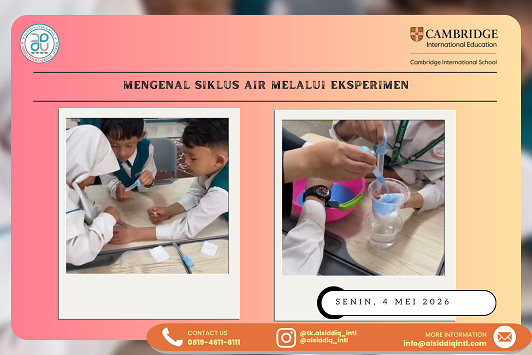
The rain experiment activity was carried out by the Kindergarten B students of Al Siddiq International on Monday, 4 May 2026, in the science classroom. This activity was one of the simple science lessons designed to introduce children to the process of how rain occurs in an engaging, enjoyable, and easy-to-understand way. Through this experiment, the children were able to learn directly by observing the changes that took place during the activity.
Before the activity began, the teacher first prepared the tools and materials to be used, namely two plastic cups, cotton wool, drawing pins, hot water, ice cubes, and blue-coloured water. The teacher then explained the function of each item to the students using simple language so that the children could better understand the purpose of the experiment. The children appeared enthusiastic and curious to follow every stage of the activity.
During the experiment, the teacher asked the children to help make small holes in the plastic cups using drawing pins under close supervision to ensure safety. Afterwards, cotton wool was placed inside the bottom of the plastic cup to represent clouds. Ice cubes were then placed on top of the cotton wool, while another cup was filled with hot water to symbolise seawater evaporating due to the heat of the sun. The teacher then dripped blue-coloured water onto the ice cubes until water droplets slowly appeared, resembling rainfall.
Through this experiment, the children learned that rain occurs through the processes of water evaporation, cooling, and the formation of water droplets that eventually fall to the earth. By directly observing this simple process, the students found it easier to understand the concept of rainfall compared to learning through theory alone. The activity also helped develop the children’s ability to observe, ask questions, and understand cause-and-effect relationships in natural processes.
The aim of this rain experiment was to introduce simple scientific concepts to children from an early age, particularly the process of how rain is formed. In addition, the activity sought to increase curiosity, encourage simple thinking skills, and build children’s confidence in trying new things. The children were also encouraged to take a more active role during the learning process.
The benefits of this activity were highly valuable for children’s development, both in terms of knowledge and skills. The children learned through direct experience, making the learning process more enjoyable and memorable. Furthermore, the experiment also helped develop fine motor skills, concentration, teamwork, and the ability to follow the teacher’s instructions. Through activities such as this, it is hoped that children will become increasingly interested in learning science and gaining a better understanding of the world around them.
By Inka Amalia, S.Pd