As part of the implementation of the Cambridge Assessment International Education curriculum, SMP Al Siddiq International School continues to provide learning experiences that encourage students to become active, creative, and innovative in facing future global challenges.
The Cambridge curriculum is widely recognised for emphasising the development of analytical thinking, problem-solving, and critical thinking skills. Through this approach, students are not only taught to understand theories, but are also trained to think critically, discover solutions, and apply learning concepts in real-life situations.
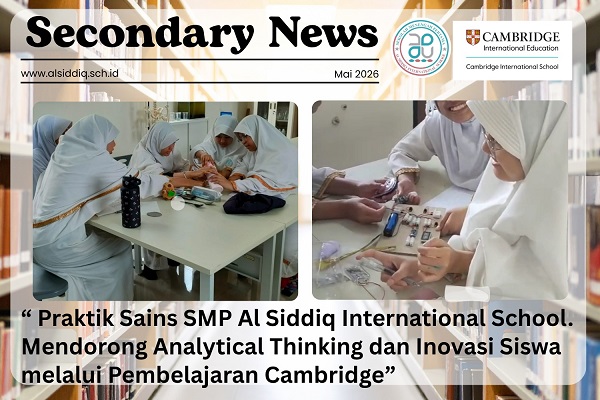
One clear implementation of this approach could be seen in the science practical activity conducted by Year 7 students in the Science Laboratory of SMP Al Siddiq International School. The activity was directly guided by the school’s science teacher, Muhammad Fathul Ihsan, M.Res, who is also a doctoral candidate at a university in Tokyo, Japan.
During the practical session, students carried out experiments on electric currents using batteries and simple electrical circuits. The learning process was conducted through group work, allowing students to discuss, exchange ideas, and collaborate in completing the assigned projects.
Through this practical activity, students were encouraged to understand how scientific concepts are directly applied in learning. They not only memorised theories, but also learned to conduct observations, analyse results, and solve problems through scientific experimentation.
This science practical programme represents one form of learning that aligns closely with the vision of the Cambridge curriculum, namely to nurture students who possess critical thinking skills, creativity, and the ability to innovate. In addition, project-based learning also helps to develop students’ self-confidence, communication abilities, and collaboration skills.
Through direct science practical activities in the laboratory, SMP Al Siddiq International School hopes to inspire a new generation with strong interests in research and technology, while also opening opportunities for future scientists and researchers who are ready to compete on a global level.
By Retno Suzanne Handa, Lc, M.Pd