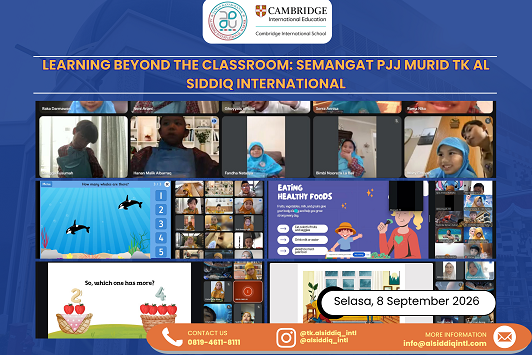
On Tuesday and Wednesday, 8–9 September 2026, students from Kindergarten A and Kindergarten B at Al Siddiq International took part in Distance Learning (PJJ) sessions via Google Meet. The programme was introduced as an adjustment to learning arrangements in response to environmental conditions around the school that were affected by volcanic ash from Mount Anak Krakatau.
Taking the children’s safety and comfort into consideration, learning activities were conducted from home so that students could continue learning and interacting with their teachers and friends in a fun and engaging atmosphere.
The implementation of Distance Learning was part of the school’s efforts to safeguard the health and safety of all students while environmental conditions were not yet suitable for face-to-face learning at school. Volcanic ash carried through the air can contain very fine particles that are easily inhaled. Exposure to significant amounts of volcanic ash may irritate the nose, throat, and respiratory tract, potentially causing symptoms such as coughing, throat discomfort, or difficulty breathing, particularly among children and individuals with sensitive respiratory systems.
Therefore, learning from home became one of the preventive measures taken to reduce exposure to volcanic ash while ensuring that learning activities could continue.
Although conducted online, the PJJ programme was carefully structured and designed to be interactive so that students could enjoy a meaningful learning experience. The activities began from 08.00 to 08.30 with Opening and Circle Time. During this session, students were encouraged to greet their teachers and friends, prepare themselves for learning, and take part in a variety of opening activities designed to create a positive and enjoyable learning atmosphere.
From 08.30 to 09.00, students participated in Murojaah, as part of the school’s routine for reinforcing and maintaining previously memorised Qur’anic passages. This was followed from 09.00 to 09.30 by Snack Time and Duha Prayer. This part of the programme gave students an opportunity to take a short break, enjoy a snack, and practise their daily acts of worship.
In this way, PJJ supported not only students’ academic development but also their spiritual growth, independence, and positive daily habits.
During the learning session from 09.30 to 10.00, activities were adapted to the developmental levels and learning objectives of each group.
On Tuesday, 8 September 2026, Kindergarten B students took part in Storytelling, Hide and Seek, and Playing, activities designed to develop language skills, understanding, and interaction through enjoyable experiences. Meanwhile, Kindergarten A students participated in School Things Hunt, an activity in which they searched for and identified various objects related to the school environment and their learning.
On Wednesday, 9 September 2026, Kindergarten B students explored the concept of comparison through Comparing: More and Fewer, using an approach appropriate to their stage of development. Meanwhile, Kindergarten A students took part in Recognising and Writing Numbers 0–5. This activity gave the children an opportunity to recognise number shapes while gradually developing their early number-writing skills.
Through the two-day PJJ programme, Al Siddiq International sought to ensure that environmental conditions did not prevent students from continuing to receive meaningful learning experiences. With the support of teachers and parents, learning activities could continue in a structured, interactive, and enjoyable way from home.
The school also remained committed to prioritising students’ health and safety by adapting the learning process according to environmental conditions.
This PJJ programme demonstrates that learning can continue through appropriate adjustments and creativity. Through Google Meet, Kindergarten A and Kindergarten B students were still able to learn, communicate, worship, play, and interact with their teachers and friends even while staying at home.
May the environmental conditions soon return to a safe and conducive state, allowing all students to resume their face-to-face learning activities at school.
Learning can happen anywhere, and with the right support, every moment can become a meaningful learning experience.
By Inka Amalia, S.Pd